









The CRM Doom Loop: Why your roofing CRM implementation keeps failing
By Adam Sand, Roofing Business Partner.
Discover the iterative approach that works for successful CRM implementation.
How many of you have felt like you're stuck in a CRM nightmare? You bought it, you set it up — or tried to — and now, it's just more work. More frustration. More money down the drain.
You're not alone. According to industry research, CRM implementation failure rates range from 30% to 70% depending on the study [Source: Gartner CRM Research, 2024]. In the roofing industry, with its unique operational complexity spanning sales, production and field service, I'd estimate that number runs even higher. I've seen this pattern play out with hundreds of companies, from $2 million operations to $40 million enterprises — and I've given it a name.
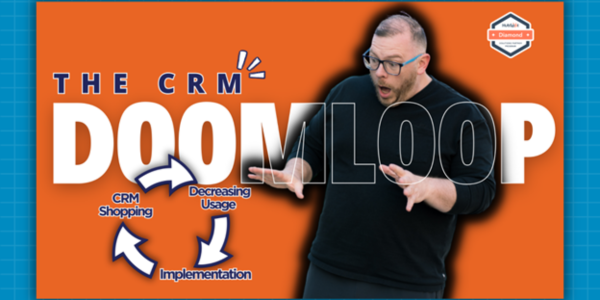
The CRM Doom Loop.
In this article, I'm going to walk you through exactly why roofing CRM implementation keeps failing, why the "all-in-one CRM" is usually a trap, and most importantly — how to escape the loop and build a system that actually works for your business.
The CRM Doom Loop explained
The CRM Doom Loop is a predictable, cyclical pattern that roofing companies fall into when trying to improve their technology systems. It has five stages, and once you see it, you'll recognize it everywhere.
 1 - Shadow silos: Departments adopt tools independently (Warning sign: "We have 3 different ways to...")
2 - Frustration build: No single source of truth, reporting nightmares.
3 - Requirements spiral: Mile-long wish lists, endless vendor meetings.
4 - Support Spider-Man: Vendors blame each other, no ownership.
5 - All-in-one illusion: You ask Facebook "What's the best CRM?", get biased advice and buy a new tool.
The trap: Stage 5 leads right back to Stage 1. You buy the new "all-in-one" system, departments start adding their own tools around it, silos form and the loop repeats. I've watched this happen with companies that spent over a million dollars trying to get their CRM right. They were on their fourth system. Same problems. Different interface.
Stage deep-dive: Shadow silos
I call them shadow app silos. Sometimes you don't even know they're there because departments are trying to solve departmental needs inside these new apps. But they create silos of data that nobody can see across.
The roofing industry's technology landscape has exploded in recent years. According to the National Roofing Contractors Association's 2024 Annual Market Survey, roofing contractors now use an average of 6-8 different software applications across their operations. You want Rilla for sales coaching. You want Hover or EagleView for measurements. You want three different tools to get different jobs done.
Real world example: You end up with three CompanyCam projects for one house because three different integrations created them. Now you have duplicate records, no single source of truth and data scattered across platforms.
How to spot shadow silos:
- How many different systems touch a single customer record?
- If you needed a complete history of a job, how many places would you need to look?
- Do different departments have "their own" tools that nobody else uses?
The support Spider-Man problem
So you get frustrated. You sit everyone down and create a mile-long requirement list. You call support for your CRM, your estimating tool and your photo tool. And it feels like you're talking to the three Spider-Mans. "Oh, that's a problem with their tool. That's a problem with their tool."
The three Spider-Man symptoms:
1 - Circular deflection: Support tickets bounced between vendors more than three times.
2 - No single owner: Nobody accountable for the total business outcome.
3 - Integration limbo: Features "work" in isolation but fail in combination.
The root cause? You've built a tech stack without an integrator — someone responsible for the connections between tools, not just the tools themselves.
The all-in-one trap
You reach the breaking point. You go to Facebook and post: "Hey. What's the best all-in-one CRM? I want just one CRM to do it all."
The uncomfortable truth: The responses you get are biased (affiliates, coaches, vendors). And the bigger truth: most CRMs are good at some things, but terrible at others. No single tool does everything exceptionally well for roofing operations.
So, you buy the new CRM, and you repeat the doom loop.
The solution: Iterative CRM approach
Here's the way out. Rather than thinking of your CRM as a destination, you want to look at it as an iterative project.
The five-step iterative implementation:
1 - Data model first: Define what a lead, contact and job are before touching software.
2 - MVP process: Start with the minimum viable process, not maximum features.
3 - Connect, don't replace: Explore integrations. Build a connected ecosystem, not a monolith.
4 - V/C/T measurement: Track volume, conversion and time.
5 - Monthly review: Set a cadence to assess and adjust.
The V/C/T framework
If you're measuring these three things, you can improve anything:
V = Volume (How much is flowing through?)
- Leads, proposals, jobs, inspections per week
C = Conversion (What percent moves to the next stage?)
- Lead → appointment (target: 40-50%)
- Proposal → close (target: 30-45%)
T = Time (How long does it take?)
- Days from lead to contact
- Days from acceptance to job start
The golden rule: Before any system changes, ask: "Will this improve our volume, conversion or time?" If the answer is no, don't do it.
Building Mission Control
Instead of asking "Which CRM should I buy?", ask "How do I orchestrate the tools I have?" This is Mission Control.
Mission Control components:
1 - Integration hub (Zapier, Make, etc.)
2 - Issue tracker (log integration failures)
3 - SOP repository (documented workflows)
4 - Health dashboard (V/C/T metrics)
5 - Review cadence (monthly meetings)
Breaking free
The CRM doom loop is real, but escapable.
Your action plan:
1 - Audit your tech stack. Map every tool; find the silos.
2 - Stop asking "What's the best CRM?" Start asking what problem needs solving.
3 - Define your data model.
4 - Implement V/C/T measurement.
5 - Build your Mission Control.
Remember: If you learn something and don't take action based on what you learned, you have learned nothing. You only get one name. Your reputation is everything. And what's right is right.
Build from there. Measure. Adjust. Improve.
Ready to escape the CRM doom loop? RBP helps roofing companies implement systems that actually work.
Learn more about Roofing Business Partner in their Coffee Shop Directory or on roofingbusinesspartner.com.
Recommended For You

MRA welcomes new alliance members
Read More ...
Employers Need an Infection Control Policy
Read More ...
Make Roof Hub your own with customization tools!
Read More ...





Comments
Leave a Reply
Have an account? Login to leave a comment!
Sign In