











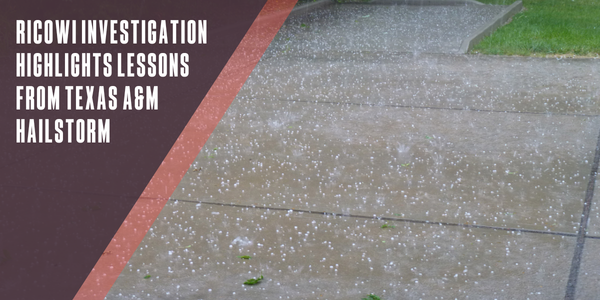
RICOWI investigation highlights lessons from Texas A&M hailstorm
By Heidi J. Ellsworth.
Findings presented during RICOWI’s spring meeting highlight how different roofing systems performed following a major hailstorm at Texas A&M University.
At the recent spring meeting of the Roofing Industry Committee on Weather Issues (RICOWI) in Sacramento, California, roofing professionals gathered to review the findings of a major hail damage investigation conducted at Texas A&M University. The meeting brought together contractors, consultants, manufacturers and researchers from across the industry, including RoofersCoffeeShop®, who participated in the event and discussions surrounding the study.
The Texas A&M case
The investigation examined roof conditions across several buildings on the Texas A&M campus following a severe thunderstorm that struck the area on March 15, 2025. The storm produced unusually large hailstones, some reported to be as large as three inches in diameter. RICOWI investigators conducted a detailed visual survey of seven campus structures in April 2025 to document roof performance, determine the causes of observed anomalies and better understand how different roofing systems respond to severe hail events.
The buildings examined in the study included Peterson Building, Liberal Arts & Humanities, Engineering Activities Building A, Scoates Hall, Blocker Building, General Services Complex Building 1800 and Clements Residence Hall. Each structure featured different roof systems, including spray polyurethane foam (SPF), modified bitumen, asphalt shingles, thermoplastic polyolefin (TPO) and standing seam metal panels.
Because hail size and intensity varied across the campus, the event created a unique opportunity to evaluate how multiple roofing materials perform under similar storm conditions. Investigators documented evidence such as hail spatter, dented metal components and areas of granule loss or membrane damage that indicated hail impacts ranging from roughly one to more than two inches in diameter.
The study found both cosmetic and functional damage across several roofing types. Metal components such as coping, flashings and rooftop equipment frequently showed dents or deformation consistent with hail impact. Asphalt shingles exhibited bruising, granule loss and gouging, conditions that can shorten the service life of the roof even if immediate leaks are not present.
Modified bitumen roofs showed circular areas of granule loss where hail impacts had dislodged the protective surface layer. This type of damage exposes the underlying asphalt to ultraviolet light, accelerating oxidation and long-term deterioration. In contrast, a 14-year-old TPO roof inspected during the study showed widespread hail spatter but no visible punctures or membrane fractures, demonstrating the resilience that some single-ply systems can exhibit under severe weather conditions.
One of the most notable findings involved spray polyurethane foam roofing assemblies used on several buildings at Texas A&M. The university’s standard system includes SPF topped with a polyurea coating, silicone layers and embedded mineral granules. Investigators observed that roofs using this full assembly experienced little to no hail damage. However, sections where the foam had not yet been coated or areas where repairs lacked the polyurea layer showed significantly more impact damage. These comparisons suggested that the polyurea component provided additional impact resistance, helping the system withstand large hailstones more effectively.
The study also highlighted the physics behind hail damage. Impact energy increases dramatically as hailstone size grows. For example, increasing hail diameter from one inch to 1.75 inches can raise impact energy nearly tenfold, while two-inch hailstones can generate roughly sixteen times the energy impact of one-inch hail. This exponential increase explains why seemingly small changes in hail size can produce significantly different damage outcomes across roofing systems.
The big picture
RICOWI’s mission is to advance knowledge about weather-related roof damage through unbiased field investigations. By documenting real-world storm events and comparing roofing system performance, the organization helps contractors, consultants, manufacturers and insurers better understand building resilience.
As discussions at the Sacramento meeting showed, studies like this provide valuable insights for the entire roofing industry. For RoofersCoffeeShop and the many professionals attending the meeting, the presentation reinforced the importance of ongoing research and collaboration to help roofing systems perform better in the face of increasingly severe weather events.
Learn more about RICOWI in their Coffee Shop directory or visit www.ricowi.com.
About the author

As CEO of The Coffee Shops, Heidi has been working and writing in the construction industry for over 30 years. She is active in many associations including founding National Women in Roofing and Roofing Technology Think Tank (RT3). She is passionate about helping to shine a light on the construction industry and creating win-win-win scenarios!
Recommended For You
Preventing Disaster: How to Stop Roof Avalanches From Happening
Read More ...
Why metal roofing delivers long-term performance
Read More ...
Stay ahead of hail with predictive weather intelligence
Read More ...




Comments
Leave a Reply
Have an account? Login to leave a comment!
Sign In