










Protecting roofers from falls — One step at a time
By Cotney Consulting Group.
Six steps to protecting your crew when they’re working with steep heights.
Falls remain the leading cause of death in the construction industry, and roofing is one of the highest-risk trades. Whether a simple repair or a large-scale commercial installation, roofing professionals face daily exposure to fall hazards, from unguarded edges and open holes to unstable walking surfaces and misused ladders.
But here’s the truth: Most fall incidents are preventable.
Fall protection isn’t just a regulatory requirement. It’s a lifesaving practice that must be embedded in every roofing company’s culture. With the right combination of planning, equipment and crew training, falls can be controlled and even eliminated.
Here’s how to protect your team one step at a time.
The real risks roofers face
Roofing crews work in environments where one wrong step can result in a life-altering injury or fatality.
Common fall hazards include:
- Unprotected roof edges
- Skylights and open floor holes
- Improperly set ladders
- Loose materials create tripping hazards
- Sloped and slick surfaces
- Weather changes create unstable footing
- Improper use or lack of personal fall arrest systems (PFAS)
Roofers aren’t falling from 50-story towers. Many fatal falls occur from heights as low as 6–10 feet, making awareness and protection even more critical.
Step 1: Plan every job with fall safety in mind
Fall protection starts well before your crew climbs a ladder. Each project should begin with a clear safety plan that answers:
- What are the specific fall hazards on this site?
- What protection systems will we use (guardrails, covers, PFAS)?
- Who is trained and competent to inspect and use the equipment?
- What’s the emergency response plan in case of a fall?
Worksite walkthroughs and pre-job briefings help identify hazards early, so there’s no guesswork when boots hit the roof.
Step 2: Protect openings, edges and holes
Unprotected sides and holes are among the most common causes of falls. OSHA requires protection when working at 6 feet or higher in construction. That means:
- Install guardrails along edges and around roof openings
- Use safety net systems when guardrails aren’t feasible
- Cover floor holes and skylights with materials that can support twice the intended load and label them clearly
- Install warning lines to alert workers to the proximity of roof edges
If you can’t remove the hazard, you must isolate it.
Step 3: Use personal fall arrest systems the right way
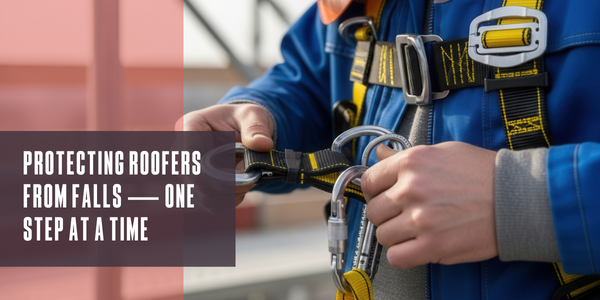
PFAS is a term that gets thrown around a lot, but not every roofer uses it properly. A complete system includes:
- A full-body harness
- A lanyard or lifeline
- An anchor point capable of supporting at least 5,000 pounds
Key safety reminders:
- Train every user on how to inspect and wear the harness correctly
- Ensure lanyards are the right length; not all roofs are the same height
- Keep anchor points above the D-ring on the harness to reduce fall distance
- Use self-retracting lifelines (SRLs) when possible for shorter fall distances and better mobility
Remember, a harness is only as good as the anchor it’s tied to. “Eyeballing it” is not a reliable method.
Step 4: Ladders aren’t a shortcut — They’re a risk
Ladders may seem basic, but they often cause many fall injuries due to rushed setups or poor conditions.
Best practices include:
- Use ladders that are the correct height and load-rated
- Place ladders on stable, level ground
- Secure ladders at the top and bottom
- Extend ladders 3 feet above the roof edge
- Maintain three points of contact while climbing
Never lean or stretch while on a ladder; move it instead. And don’t use makeshift ladders or substitutes, like pallets or stacked materials.
Step 5: Train, supervise and reinforce
Fall protection equipment only works if it’s used correctly and consistently. That’s why every roofer, regardless of experience, should receive training on:
- Recognizing fall hazards
- Correct use of PFAS
- Ladder safety
- How to install guardrails and covers
- Emergency rescue procedures
Make fall safety a recurring topic in toolbox talks. Empower your forepersons and safety leads to intervene if they see unsafe behavior.
Step 6: Maintain and inspect your gear
Before every use, inspect fall protection gear for:
- Frayed or damaged webbing
- Broken buckles or D-rings
- Rusted or corroded metal parts
- Worn anchor points or connectors
Damaged equipment must be removed from service immediately. Don’t leave harnesses and lanyards baking on a dashboard or tossed in a trailer. They’re lifesaving tools, not throwaways.
Final thoughts: Fall protection isn’t optional — It’s fundamental
In the roofing industry, the risks and stakes are real. One misstep missed anchor, and overlooked opening can change a life forever. But the solutions are in your hands: plan, provide the right equipment, train your people and enforce safety from the top down.
Protecting roofers from falls doesn’t require a miracle; it takes commitment one step at a time.
Learn more about Cotney Consulting Group in their Coffee Shop Directory or visit www.cotneyconsulting.com.
Recommended For You

DOL urges plan to protect outdoor workers from poor air quality
Read More ...
The Sound of Safety
Read More ...
Enhancing safety with tailgate meetings
Read More ...



Comments
Leave a Reply
Have an account? Login to leave a comment!
Sign In