







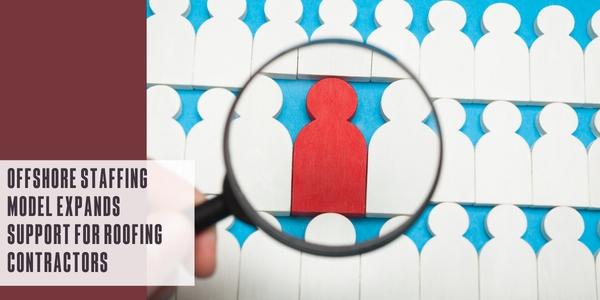
Offshore staffing model expands support for roofing contractors
By Jesse Sanchez.
A growing approach to hiring, training and onboarding is helping contractors fill operational gaps without adding internal overhead.
As roofing contractors contend with ongoing labor shortages and rising operational complexity, attention is shifting toward staffing models that extend capacity without increasing internal burden. Among them, offshore workforce support is emerging as a practical solution, allowing companies to delegate time-intensive administrative, sales and insurance-related tasks to trained remote professionals.
That approach was on display at the 2026 International Roofing Expo (IRE) in Las Vegas, where Kevin Wall of DCX described how the model functions within day-to-day operations. DCX provides hiring, onboarding and training services that connect contractors with remote employees based in the Philippines. Those workers integrate into front- and back-office roles, supporting functions such as accounting, marketing and insurance processing while maintaining full-time schedules aligned with U.S. business hours.
Central to the model is a streamlined hiring process designed to reduce uncertainty. Contractors are matched with candidates based on defined needs, then guided through a structured interview process. The result, Kevin noted, often reshapes expectations early. “This is the best set of candidates I've ever interviewed,” he said, describing feedback commonly shared by contractors after initial interviews.
From there, the focus shifts to readiness. DCX prepares candidates through a four-week roofing academy that introduces industry terminology, workflows and software platforms before placement begins. A separate training track targets insurance-related work and estimating tools, equipping workers with the technical foundation required to contribute immediately.
That upfront investment in training addresses a persistent concern among contractors; whether remote employees can integrate effectively into existing teams. According to Kevin, many of these workers already have experience supporting U.S.-based companies and have adapted to overnight schedules to match contractor time zones, allowing them to operate as a consistent extension of the business. Kevin shared, “A lot of these Filipino employees have at least one to two years working for US-based companies working those hours.”
Flexibility remains a defining feature of the model. Without long-term contracts, contractors can evaluate performance without committing to permanent structural changes. “Give these workers a chance,” Kevin said. “If you're curious, let's start the conversation.”
As workforce constraints continue to shape the industry, models that combine scalability, training and operational continuity are becoming an increasingly viable path forward for contractors seeking to stabilize and grow.
Learn more about Delegate CX in their Coffee Shop Directory or visit delegatecx.com.
About the author

Jesse is a writer for The Coffee Shops. When he is not writing and learning about the roofing industry, he can be found powerlifting, playing saxophone or reading a good book.
Recommended For You
Advanced bitumen membranes for commercial roofing
Read More ...
The Cascade shingle is taking roofing to new heights
Read More ...
These Two Companies are Working Together and Saving Contractors Time!
Read More ...





Comments
Leave a Reply
Have an account? Login to leave a comment!
Sign In