









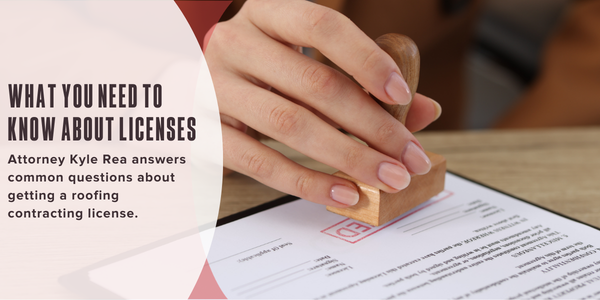
What you need to know about licenses
By Emma Peterson.
Attorney Kyle Rea answers common questions about getting a roofing contracting license.
In a new episode of Roofing Road Trips®, Megan Ellsworth had the chance to sit down with Kyle Rea, an attorney from Adams and Reese law firm, to ask him some of the most pressing questions roofing contractors often have about licensing.
Do I need a license?
It might sound like a basic question, but it is an important one, and the answer is a bit more complicated than you might think. Kyle explained:
It's important to know what the laws are in the state that you're doing business. There are some states that have really overarching, strict licensing laws when it comes to roofing. And there are other states where it is totally the wild, wild west, and they don’t even require a license.
The crucial thing to understand is that licensing laws are based on where projects are, not where you are headquartered. As Kyle put it, “You gotta be careful. If you operate out of one state and start inching closer to another state, you have to know their requirements. Because you could be doing something perfectly okay in the one state and totally wrong for the other state.”
How do you keep up with the different requirements? Kyle recommends calling building departments. He explained, “They're going to give you the stock response of ‘I'm not an attorney and I can't give you legal advice,’ but they can still give you resources that you can utilize to kind of make that determination.” Licensing board websites are also a great resource.
If not every state requires them, why are licenses important?
Kyle shared some thoughts:
In the states that require it, it is essentially your permission slip to work. And not only does it outline that you can work, it also outlines what you can do...So you might be doing roofing, that might be the predominant major portion of the contract that you're engaged in, but if you find yourself kind of inching towards these other different trades, that could potentially get you in hot water.
This might seem frustrating from the contractor's perspective, but it is often something that protects homeowners from bad actors looking to make a quick buck. At their core, licensing laws are consumer protection; their goal is to make sure that people can trust that the contractors they’re hiring are conducting their business in a strict and proper manner.
What happens if you make a mistake with licensing?
If you’re caught without a proper license or working beyond the bounds of your license, a range of issues can arise, from being held administratively responsible to criminal charges. Kyle explained:
A state licensing board can come in and say, ‘hey, you overstepped your bounds.’ And this can lead to everything from your contract being voided, fines being posted against you, a revoking of your license, the placement of your operations on probation, etc. And in some cases, it can escalate even further, I think in every state other than New York, unlicensed contracting is considered a crime.
How do I make sure all my licensing ducks are in a row?
So, how do you avoid running into contracting license issues? First and foremost, make sure you’re following Kyle’s earlier advice and do your research about what you are required to have to work in different areas. Second, make sure that you’re aware of common pitfalls and friction points, such as:
- Subcontractor licensure: Similar to contractor licenses, the rules for subcontractors can vary between states, but, according to Kyle, in general, “The majority of states are going to require that a subcontractor also be licensed to perform the work that you are asking them to do. So, it's not enough just for you to have a roofing license, but if a roofing license is required, your subcontractors also have to have those licenses.”
- Scope creep: We’ve all had projects where customers just add ‘one more thing’ to the plan. This is normal, but Kyle highlighted that it is important that when they ask, “You take a moment to ask yourself, ‘Does this work that I'm being asked to do that may not necessarily be within the purview of what I normally do on a day-to-day basis? Does this require different licensure?’ And if it falls out of your license, you need to be confident and offer them a referral to someone else rather than just doing it yourself.”
Listen to the whole episode or Watch the recording to learn more about navigating licensure.
Learn more about Adams & Reese LLP in their Coffee Shop Directory or visit www.adamsandreese.com.
The information contained in this article is for general educational information only. This information does not constitute legal advice, is not intended to constitute legal advice, nor should it be relied upon as legal advice for your specific factual pattern or situation.
About the author

Emma is the senior content developer at The Coffee Shops and AskARoofer™. When she's not working or overthinking everything a little bit, she enjoys watching movies with friends, attending concerts and trying to cook new recipes.
Recommended For You
Set the stage for single-ply success
Read More ...
Focusing on fire-resistance
Read More ...
Making the most of your daily productivity
Read More ...



Comments
Leave a Reply
Have an account? Login to leave a comment!
Sign In