











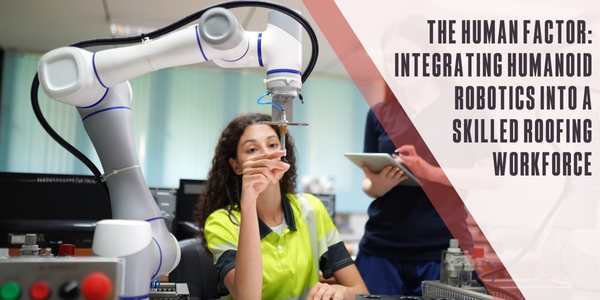
The human factor: Integrating humanoid robotics into a skilled roofing workforce
By Cotney Consulting Group.
Humanoid robotics does not change the fundamentals of good management. It exposes whether those fundamentals exist.
Up to this point in the series, the discussion has focused on readiness operations, realistic entry points and the environments where humanoid robotics is most likely to appear first. Those factors matter. But they are not what will determine success or failure.
The real deciding factor will be people.
Technology does not integrate itself into a workforce. Leadership does. And in an industry built on experience, trust and accountability, how that integration is handled will matter far more than how advanced the technology becomes.
Workforce resistance is often misdiagnosed
When new technology enters construction, resistance is usually blamed on attitude. In reality, what most crews experience first is uncertainty. Roofing professionals have seen wave after wave of change: new materials, new safety rules, new documentation requirements and new software platforms. Many of those changes were introduced with little explanation of how they affected daily work. That history matters.
When humanoid robotics enters the conversation, the questions crews ask are practical:
- Who is responsible?
- How does this affect safety?
- Does this slow the job down?
- What does this mean for my role?
If leadership does not answer those questions clearly, crews will answer them themselves. That is where fear takes hold, not because people oppose progress, but because they lack context.
Culture will decide adoption long before capability does
In earlier articles, we made a clear distinction between automation and replacement. That distinction only holds if leadership reinforces it consistently. Workforce culture is shaped by what leaders tolerate and what supervisors reinforce—not by policy statements or kickoff meetings. If robotic tools are introduced without clear boundaries, ownership and accountability, they will be viewed as threats or distractions.
We’ve seen this happen with estimating platforms, project management software and inspection tools. The technology worked. The rollout didn’t. Humanoid robotics raises the stakes because it operates next to people, not behind a screen.
Supervisors are the pivot point — Whether they want to be or not
No group will influence integration more than supervisors. Foremen, superintendents and service managers sit at the intersection of planning and execution. If they are uncertain, uncomfortable or unconvinced, the workforce will follow their lead.
Supervisors will need clarity around:
- Task boundaries between people and machines
- Safety oversight in shared work zones
- Workflow sequencing and exceptions
- Accountability when conditions change
This does not require turning supervisors into engineers. It does require preparing them to manage systems, not just tasks. Companies that already invest in supervisor development will feel this shift less acutely. Others will feel it immediately.
Robot-integrated crews: A practical operating model
To keep this discussion grounded, it helps to define the operating model. Robot-Integrated Crews are not crews replaced by machines. They are crews supported by clearly defined robotic assistance.
In this model:
- Humans retain authority over planning, execution and quality
- Robots assist with defined activities such as staging, inspection support or access
- Responsibility for outcomes remains human-owned
- Safety oversight is explicit, not assumed
This framing matters. It reinforces that robots are tools within the crew, not independent actors — and that leadership accountability does not change.
Training is about context, not controls
One of the most common misconceptions is that workforce training for robotics will be highly technical. In reality, most workers will never interact with control systems or programming.
What they need is context:
- What the robot supports
- What it does not do
- How to work safely around it
- When to escalate issues
- Who remains responsible
This is closer to safety orientation than equipment certification. Clear context reduces misuse, lowers anxiety and keeps the focus on productivity and safety rather than novelty.
Leadership must set the narrative early
If leadership waits until technology arrives to address workforce concerns, it is already too late.
The narrative needs to be established well in advance:
- Why the company is exploring automation
- How it aligns with safety and sustainability
- What it does and does not mean for jobs
- How people remain central to success
This conversation should not be framed around labor reduction. It should be framed around risk reduction, consistency, and long-term competitiveness. When leaders own the message, crews listen. When they avoid it, speculation fills the gap.
Workforce readiness is operational readiness
One consistent theme in this series is that preparation is not about tools. It is about discipline. Workforce integration follows the same rule. Companies that already communicate clearly, train consistently and invest in leadership development will adapt more smoothly than those relying on informal systems.
Humanoid robotics does not change the fundamentals of good management. It exposes whether those fundamentals exist.
What this series will explore next
In the following article, we will shift focus again, this time to operations.
Specifically, we will first examine the operational blind spots that automation will expose, ranging from job costing and asset ownership to safety governance and accountability. These are the pressure points that determine whether automation becomes an advantage or a liability.
Understanding them now is far less painful than discovering them later.
Learn more about Cotney Consulting Group in their Coffee Shop Directory or visit www.cotneyconsulting.com.
Recommended For You

The estimate doesn't end when the bid is submitted
Read More ...
Build stronger businesses and faster teams at METALCON
Read More ...
Unlocking the value of your roofing business
Read More ...





Comments
Leave a Reply
Have an account? Login to leave a comment!
Sign In