













The contractor’s role in asphalt shingle recycling and sustainability
By Dani Sheehan.
Discussions from the 2025 ARMA Recycling Forum highlighted the growing role contractors play in sustainability, recycling and long-term roof performance.
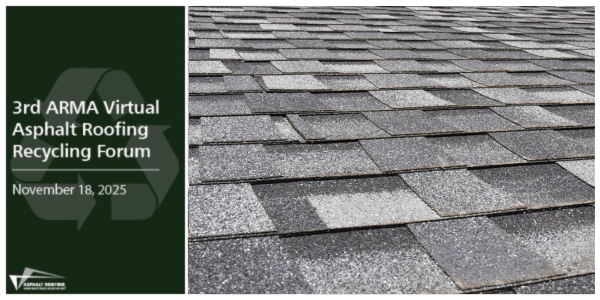
As conversations around sustainability, recycling and circularity continue to grow in the construction industry, roofing contractors increasingly find themselves at the center of the discussion. The 2025 ARMA Virtual Roofing Recycling Forum hosted by the Asphalt Roofing Manufacturers Association (ARMA) brought together researchers, manufacturers, trade associations and sustainability experts to explore where the industry is today and where it’s headed.
While the technical details are still evolving, three clear takeaways emerged that will benefit you as sustainability expectations continue to evolve.
1 – Contractors are the key connector in roofing sustainability
One of the strongest messages from the forum was the role contractors already play, and will continue to play, as the go-between for the entire roofing ecosystem. You sit at the intersection of building owners, manufacturers, designers, general contractors and local jurisdictions, all of whom influence how a roof is specified, installed, maintained and ultimately removed.
From a recycling and sustainability standpoint, this puts you in a unique position. Most contractors are focused on delivering the roof the customer needs, on time and on budget. But as local regulations increase, disposal costs rise and sustainability expectations vary by region, you are often the ones navigating restrictions, liability concerns and logistical challenges.
The forum emphasized that this role can be viewed as a risk, or an opportunity. When you understand the basics of recycling options, durability, repairability and waste reduction, you are better positioned to guide owners through informed decisions. In many cases, simply being able to explain what is and is not available locally already adds value. Education is the first step.
2 – Recycling is market-driven, local and uneven, but growing
Recycling of asphalt roofing materials is not advancing evenly across the U.S., and while national recycling rates have fluctuated, local and regional programs are expanding – often driven by disposal costs, transportation economics and regional policy rather than federal mandates.
Some states actively allow recycled asphalt shingles (RAS) in paving applications, while others restrict or prohibit their use due to agency specifications or material concerns. Even in states where RAS is permitted, adoption may be limited by processing infrastructure, moisture control challenges or quality requirements. In short: availability is local, and contractors should not assume recycling options exist everywhere.
That said, the forum highlighted a key point: recycling does not move forward unless people in the area ask for it. Where contractors and building owners express demand, recyclers and processors are more likely to enter the market. Tools like CDRA’s shinglerecycling.org zip code search are a practical starting point for understanding what options exist in your region today.
3 – Durability, longevity and repairability still matter most
While recycling and circularity are gaining attention, the forum reinforced that the most sustainable roof is still the one that lasts longer and performs better. From manufacturers to contractors, there is significant overlap in priorities. Long-lasting materials, systems that can be repaired instead of replaced, reduced heating and cooling loads and strong warranties all contribute to lower environmental impact — often before recycling ever enters the picture.
Sustainability is not just about end-of-life solutions; it’s about system selection, proper installation and maintenance throughout the service life of the roof.
What this means for the future
If there was one consistent takeaway from the forum, it’s that you don’t need to become sustainability experts overnight. But you can benefit from learning about recycling options, durability strategies and emerging industry resources to better answer customer questions and navigate evolving regulations.
Several industry resources aim to make that easier. Clemson University offers free educational materials based on their sustainability and resiliency research for the roofing industry, while NRCA’s latest sustainability report and ARMA’s technical bulletin on asphalt recycling offer practical guidance on waste reduction and lifecycle thinking. Additional research in the industry is focused on developing life cycle assessment data to better quantify the environmental impacts of asphalt roofing and recycling programs.
As sustainability conversations continue to evolve across construction, your ability to stay informed and educate customers can influence decisions that help shape not just the performance of a building, but the future of roofing materials long after the project is complete.
Learn more about Asphalt Roofing Manufacturers Association (ARMA) in their Coffee Shop Directory or visit www.asphaltroofing.org.
About the author

Dani is a writer for The Coffee Shops. When she's not writing or researching, she's exploring new hiking trails or teaching yoga classes.
Recommended For You

Climate has shaped roof design for more than 1,000 years
Read More ...
Green Roofs on Schools Benefits Kids and Boost Sustainability
Read More ...
New HelioVolta Report: Poor project quality increases lifetime solar energy costs by more than 20%
Read More ...





Comments
Leave a Reply
Have an account? Login to leave a comment!
Sign In