










Reduce adhesive use and labor costs with extended tapered panels

By Jesse Sanchez.
Learn how extended panel layouts in tapered polyiso systems can lower adhesive use, reduce material handling and improve overall installation efficiency.
Designing a tapered roof system with Hunter Panels requires more than meeting slope requirements, it demands a careful balance between material expense and labor efficiency. Specialty components such as prefabricated target sumps, hips, valleys and extended panel profiles can influence that balance, but the true impact depends on how the tapered layout is configured.
Adhesive is one of the most significant cost drivers in a multi-layer tapered system. The more insulation layers required to achieve slope, the more adhesive is needed to secure them. In a standard 1/8-inch taper profile with a four-panel repeat across a 64-foot run, layers of 2-inch flat insulation are stacked at each repeat to build elevation. This approach results in 40 panels of application, increasing both adhesive usage and installation time. On a roof measuring 64’x64’ this approach would result in 103 applied square and four applications of adhesive
Reconfiguring the same 64-foot run with extended panels changes the equation. By increasing the panel repeat, the design reduces the number of required insulation layers, bringing the total application down to 24 panels and immediately lowering adhesive demand. The resulting final panel reflects 1 layer of 4” fill and the “FF” panel needing to be adhered. On a roof measuring 64’x64’, the extended panels would result in 82 applied square and two applications of adhesive.
While this example highlights a 1/8-inch profile, extended panels are also available in 3/16-inch, 1/4inch, 3/8inch and ½-inch slopes, offering flexibility across a range of tapered system designs.
Learn more about Hunter Panels in their Coffee Shop Directory or visit www.hunterpanels.com.
About the author

Jesse is a writer for The Coffee Shops. When he is not writing and learning about the roofing industry, he can be found powerlifting, playing saxophone or reading a good book.
About Hunter Panels
Hunter Panels, headquartered in Portland, Maine, has been the leader in thermal efficient Polyiso insulation for roof and wall applications since 1997. Thermal efficiency and sustainability are two cornerstones for Hunter Panels. Products contain no HFC’s, CFC’s or HCFC’s. Hunter Panels currently manufactures its product from seven facilities in New York, Illinois, Florida, Texas, Utah, Washington and Pennsylvania. Learn more about Hunter Panels at www.hunterpanels.com.
Recommended For You
The secret to managing commercial roofing projects
Read More ...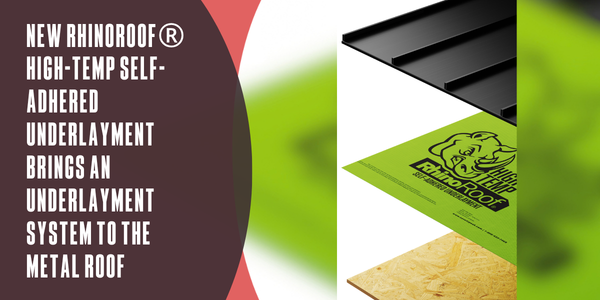
New RhinoRoof® High-Temp self-adhered underlayment brings an underlayment system to the metal roof
Read More ...
Spray foam belongs on the spec sheet
Read More ...



Comments
Leave a Reply
Have an account? Login to leave a comment!
Sign In