











Mission control systems strengthen roofing operations beyond CRM
By Jesse Sanchez.
Learn why traditional CRM systems fall short in roofing and what a system must control to drive consistency and growth.
For many roofing contractors, the push to find a better customer relationship management (CRM) platform, a challenge often addressed by companies like Roofing Business Partner, begins with operational friction. Teams work across disconnected systems, reports fail to reflect reality and processes break down as projects move from one department to the next. While these challenges are often attributed to software limitations, the underlying issue is more structural; it is a failure of how the system is designed to function.
That distinction becomes clear when viewed through the lens of how roofing businesses actually operate. Unlike industries built on repeat transactions or predictable service models, roofing is defined by high-value, infrequent projects that require coordination across multiple roles. From the first customer interaction through inspection, production, billing and warranty, each phase is interdependent. When one stage lacks clarity, the effects ripple across the entire job.
In response, many companies attempt to close those gaps by adding more tools. Platforms for documentation, measurements, accounting and communication are introduced to solve specific needs. Over time, however, this approach often produces the opposite effect. Information becomes fragmented, workflows lose continuity and visibility declines. As a result, leadership is pulled deeper into day-to-day coordination, relying on meetings, spreadsheets and manual follow-ups to maintain control.
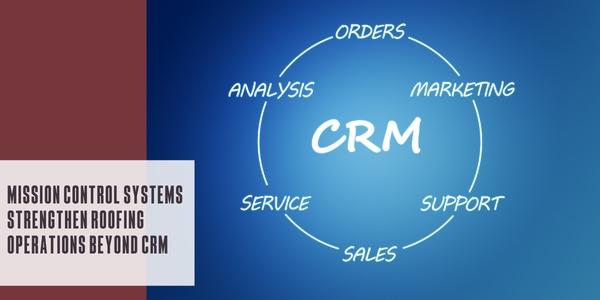
Within that environment, the idea of “Mission Control” reframes what a CRM is expected to do. Rather than serving as a static database or sales tracker, the system must operate as the central point of coordination for the entire customer journey. It is where information aligns, responsibilities are defined and each next step is clearly established.
To function at that level, the system must consistently manage five core elements: a single, unified customer timeline, structured workflows that guide execution, integrations that keep tools connected, clear ownership at every stage and reporting that accurately reflects performance. When any of these components are missing, even sophisticated platforms lose their effectiveness and revert to passive record-keeping.
The appeal of all-in-one solutions often emerges from the desire to simplify this complexity. In practice, however, consolidation rarely eliminates it. When those systems cannot meet specialized needs, teams introduce additional tools, re-creating the same fragmentation they were intended to solve.
Companies that break out of this cycle shift their focus. Instead of asking which CRM is best, they define what their system must control. From there, they build with intention, aligning tools, workflows and data around the realities of their operation.
In roofing, growth is not driven by lead volume alone. It depends on the ability to manage complexity with consistency. Systems that function as true Mission Control provide that foundation, turning fragmented processes into coordinated execution and positioning contractors to scale with greater confidence.
Learn more about Roofing Business Partner in their Coffee Shop Directory or on roofingbusinesspartner.com.
Recommended For You
Top 5 Reasons to Use a Complete Roofing System
Read More ...
Georgian style meets modern exterior performance
Read More ...
Unique Innovation Leads to Roofing Granule Success
Read More ...





Comments
Leave a Reply
Have an account? Login to leave a comment!
Sign In