











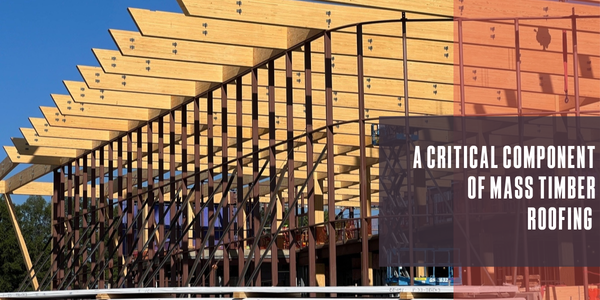
A critical component of mass timber roofing
By Dani Sheehan.
With its combination of durability, vapor permeability and compatibility with single-ply roof assemblies, SlopeShield® is a foundational element of mass timber roofing design.
As mass timber becomes a preferred structural system for commercial and institutional projects, roofing contractors are encountering a new challenge at the core of these buildings: moisture control. In a recent episode of Roofing Road Trips®, Chris Meyer and Aaron Gould from VaproShield® explain how products like SlopeShield® are becoming essential tools for contractors tasked with protecting these innovative structures.
Mass timber demands better moisture protection
Because mass timber panels must stay dry to maintain structural performance and visual quality, roofing contractors are increasingly taking the lead on moisture protection strategies. As Aaron explained, even normal construction exposure can create problems if vapor isn’t allowed to escape: “The dryability being measured in perms… the ability of the moisture that's in the wood if it gets elevated too much to be able to dry out passively through the membrane system, similar to Gore-Tex, is key.”
Vapor-permeable systems like SlopeShield Plus SA keep bulk water out while still allowing the timber to dry through the membrane.
A durable membrane
One reason SlopeShield is gaining traction is its ability to serve as both temporary protection and a permanent air/vapor control layer. Contractors are using it the moment panels hit the site and then incorporating it directly into the final roof system.
Aaron described a local bank project where glue-laminated panels arrived from the factory with the membrane already installed: “We used the SlopeShield Plus membrane as a temporary protection during construction, and then it also became permanently part of the air barrier system.” The dual use saves time, reduces rework and ensures continuity of the air and vapor control layer.
Most low-slope construction projects are complex, with multiple trades working on the deck before the roofing is finished. Chris Meyer emphasized how surprisingly durable SlopeShield is: “Roofs are a harsh environment, especially when you have crews up there working… To this day the only complaint we’ve gotten was when a scissor lift tore the product because someone spun the wheels without moving it.”
If concrete can be damaged under the same conditions, Chris joked, you can’t expect a membrane to perform miracles. But the point stands: SlopeShield holds up in real-world roofing conditions where foot traffic, equipment and staging are unavoidable.
Why vapor management is critical on low-slope mass timber
As mass timber buildings grow larger, architects are turning to low-slope single-ply roof assemblies, including reflective TPO systems. While reflective membranes lower surface temperatures and reduce the heat island effect, they also reduce the roof’s natural ability to dry. That makes controlling vapor and limiting moisture intrusion even more important.
Chris noted, “You’re lowering the temperature of that roof… so something that stops moisture from getting in there is always a benefit. It really does add to the total cost of ownership for the building owner.” A drier roof means better insulation performance, fewer callbacks and longer-lasting assemblies.
Listen to the full podcast to learn more about moisture management and mass timber construction.
Learn more about VaproShield in their Coffee Shop Directory or visit www.vaproshield.com.
About the author

Dani is a writer for The Coffee Shops. When she's not writing or researching, she's exploring new hiking trails or teaching yoga classes.
Recommended For You
The case for composite
Read More ...
Creating a more fire-safe future
Read More ...
Learn How to Best Train and Certify Your Estimators
Read More ...


Comments
Leave a Reply
Have an account? Login to leave a comment!
Sign In