









Why roof cover boards matter for long-term roof performance

By PIMA.
HD polyiso cover boards help maintain roof durability by resisting impact, improving rigidity and supporting systemwide performance in severe weather.
One critical piece of the roofing system that protects the roof assembly is the roof cover board. Roof cover boards endure hail, winds, rooftop traffic and the weight of rooftop equipment, all of which can put stress on the roof structure and even disrupt the overall roof assembly. To counter these pressures, most modern roof designs incorporate a protective layer that helps preserve long-term performance.
Our team at Polyisocyanurate Insulation Manufacturers Association (PIMA) created this technical bulletin so you can learn the basics and the importance of polyiso insulation and roof cover boards.
How do cover boards protect roof systems and enhance durability?
Products like high-density (HD) polyiso cover boards are installed below the roof membrane and above the insulation layers. Cover boards are manufactured with higher compressive strengths as compared to other roof assembly layers. This hard surface dissipates energy from impact forces generated by hail, dropped tools and even foot traffic from roof and equipment maintenance personnel. In high wind scenarios, the rigidity of cover board materials reduces the risk of deflection uplift forces.
How are roof cover board materials evaluated?
While the performance attributes of roof cover board materials include R-value and water absorption, it is compressive strength that defines the role of cover boards as a protection layer. The compressive properties of HD polyiso cover boards are evaluated using ASTM D1621, "Standard Test Method for Compressive Properties of Rigid Cellular Plastics." Under this laboratory test method, loads are applied until deformation of ten percent (10%) of thickness or yield, whichever occurs first, is observed.
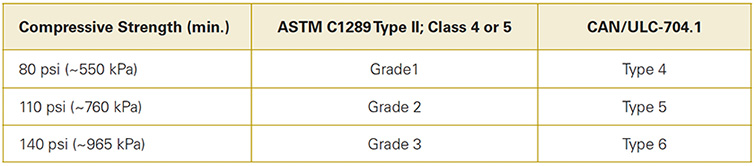
Roof cover board materials are available in a range of compressive strengths. While gypsum roof cover board products are manufactured with higher compressive strength values, HD polyiso cover boards deliver fir-for-purpose protection for most roofing scenarios. Table 1 includes the minimum compressive strengths for HD polyiso cover boards as required under the applicable product standards in the United States and Canada.
Table 1. Minimum requirements for compressive strength of HD polyiso roof cover boards by product standard.
How do HD polyiso and gypsum roof cover boards compare?
Is more always better when it comes to compressive strength? No. While gypsum roof cover boards are manufactured in higher compressive strengths, the products can provide over engineered solutions for most roofing scenarios.
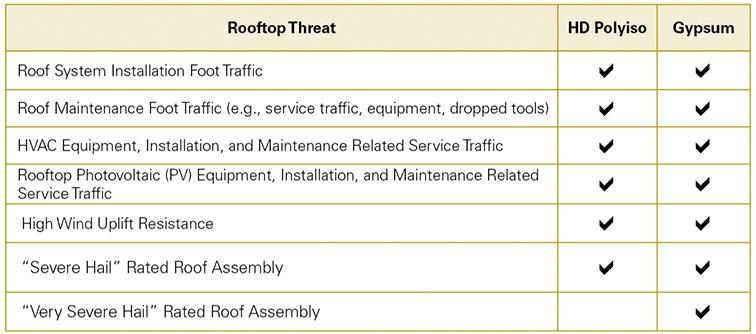
Like other factors for roof system performance, products should be selected with the entire assembly in mind. For certain hazards such as wind and hail, the entire roof assembly is evaluated and classified based on its level of performance. For example, roof assemblies evaluated for puncture resistance when exposed to hail are classified for "Severe Hail" or "Very Severe Hail." Roof assemblies that include HD polyiso cover boards can meet the "Severe Hail" performance requirements, which cover a significant portion of the U.S. regions that face severe hail threats.
Roof cover boards should deliver fit-for-purpose performance when it comes to protecting roof assemblies against anticipated hazards. Table 2 compares how HD polyiso cover boards can deliver equivalent performance to gypsum products when the performance of the full roof assembly is considered.
Table 2. Comparison of HD polyiso and gypsum roof cover boards by rooftop threat.
Summary: Cover boards and compressive strength
- Assembly performance: For weather threats like hail and high winds, roofs are evaluated as a complete assembly. In most cases, HD polyiso coverboards can be used to meet the applicable assembly performance criteria.
- Fit-for-purpose: The available compressive strengths for HD polyiso cover boards provide suitable protection for most roofing scenarios versus the over engineered solutions found in gypsum options.
- Additional protection: Where excessive or regular foot traffic is expected, roof system designers can implement the use of foot traffic pads as a best practice for directing and limiting the impacts of foot traffic on roof systems.
Additional benefits
HD polyiso cover boards deliver enhanced roof protection, but the advantages go beyond durability:
- Widely available from more than 40 manufacturing sites in the U.S. and Canada.
- Reduced freight and fewer trucks with single source shipping of both insulation and cover board products.
- Provides a high R-value of R-2.5 when compared to alternative cover board options.
- Lightweight boards for ease of installation (roughly 1/5 the weight of 1/2 inch gypsum boards).
- Easy to cut without the need for special tools and virtually dust free.
Before installing HD polyiso cover boards, project teams should always consult manufacturer data sheets for information on product performance and installation instructions.
Original article and photo source: PIMA
Learn more about Polyisocyanurate Insulation Manufacturers Association (PIMA) in their Coffee Shop Directory or visit www.polyiso.org.
Recommended For You
Día 1: Sesiones clave en IRE 2025
Read More ...
How to not regret selling your roofing company
Read More ...
Lessons in trust, grit and discipline
Read More ...

Comments
Leave a Reply
Have an account? Login to leave a comment!
Sign In