











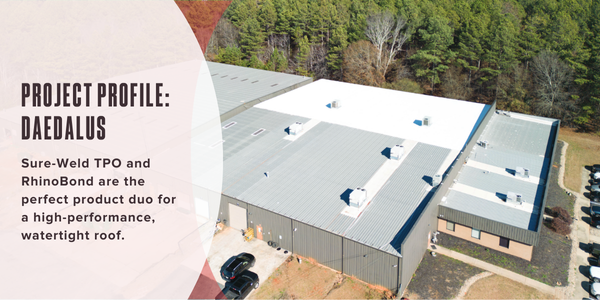
Project profile: Daedalus
By Emma Peterson.
Sure-Weld TPO and RhinoBond are the perfect product duo for a high-performance, watertight roof.
Daedalus Industrial, which specializes in designing, building, installing and maintaining custom automation systems (often found in data centers, government systems and manufacturing facilities), was in need of a new roof. Their Easley, South Carolina, facility’s 65,000-square-foot standing seam metal roof was nearing the end of its service life, and they need a quick and effective solution to keep the sensitive design and processing equipment inside the facility safe.
With the help of roofing experts, they found the perfect solution: A combination of the induction-welding-based RhinoBond® system and Carlisle’s 16-foot-wide Sure-Weld® TPO membrane. Keep reading to learn about this powerful duo and how it helped Daedalus keep their facility secure.
Why Sure-Weld TPO and RhinoBond
When it comes to re-roofing a standing seam metal roof, there’s nothing faster or easier than the induction-welding-based RhinoBond® system, especially when combined with Carlisle’s 16-foot-wide Sure-Weld® TPO membrane. That’s because unlike traditional roofing assemblies, fasteners for the RhinoBond system are installed into the purlins for maximum uplift strength, but they do not have to be placed in the seams of the membrane, which eliminates the need for purlin-width sheets of membrane. This not only can improve rooftop productivity but also reduce waste and increase project profitability.
“There’s no easier way to handle a metal roof retrofit project,” said Patrick Poirier, project manager for Radco Roofing, a large NRCA-member contractor headquartered in Charlotte, North Carolina, serving the southeastern U.S., that specializes in all aspects of commercial roofing. Their services include installation, maintenance and sheet metal work. He went on, “The induction-welding system requires fewer fasteners and does not penetrate the new membrane. For prescriptive fastening, we just install more of the special Carlisle RhinoBond plates as additional attachment points, and the 16-foot-wide rolls reduce the overall seaming by 33 percent. It’s really a no brainer!”
Using the products in practice
It was for these reasons that Radco Roofing, hired specifically for this project, recommended the combo. Patrick explained, “Unlike many typical metal roof recovers, Radco was hired only to recover one half of one of the three roofs at the Daedalus facility.” The 15,000-square-foot section of the roof which needed to be recovered included two air handling units on curbs, as well as several 3 x 10-foot translucent panels that were removed and replaced with new R-panel decking.
Once the new decking was in place, the crew of 8-12 roofers from Radco started the recover process. The first step was to fill the flutes using loose laid EPS insulation. Once in place, the crew installed a 1-inch layer of Carlisle InsulBase Polyiso Insulation, a rigid roof insulation panel designed for single-ply systems. “We secured the insulation to the deck using Carlisle InsulFast Fasteners and 3-inch insulation plates,” said Patrick. “The polyiso provided us with a good, flat substrate for the membrane.”
Next, in preparation for the membrane, the crew installed the RhinoBond plates. “Since we were only re-roofing half of the building, we had to make sure that wind would not be an issue,” said Patrick. “So, we installed the RhinoBond plates with Carlisle HP purlin fasteners at 12-inches on center across the ridge and on the next two purlins, and then on the bottom three purlins at the eave. For the purlins in between, we installed the plates on every other purlin with the same 12-inch OC spacing.”
Purlin spacing on the Daedalus facility was 5 feet wide. Traditionally, contractors would have to order a special width membrane for these applications to match the purlin spacing. But with the induction-welded system, the membrane width is not an issue because the seams do not have to be over the purlins.
 Due to the size and weight of the 16 x 100-foot rolls, staging the roof properly was important. Patrick shared, “We had a lift deliver the first rolls of membrane all the way to the ridge, so we could work down the roof to the eave. This was the first time that we worked with the 16-foot rolls, and we really liked the way they handled, as well as the productivity we got on this project.”
The three-inch round induction plates are coated with a special hot-melt adhesive. Once the membrane is rolled out over the top, an induction welder is placed over each plate and activated. The electromagnetic induction process heats the plate below and fuses the bottom of the membrane to the top of the plate in about five seconds. A magnet is then placed on top of the membrane directly over the plate to help cool the plate and promote a strong bond.
On the front end of the building, the roof had a parapet wall that served as a divider with the lower office section of the building. To address the parapet, Radco added new plywood to the inside of the wall, terminated the membrane at the base, then fully adhered to the membrane up and over the wall and capped it with shop-bent coping.
Terminating the membrane at the ridge was a bit more challenging. When rolling out the first sheet of membrane, the crew from Radco left a foot or so hanging over the ridge. Next, they installed wood blocking and terminated the membrane with plates and a termination bar to the deck where appropriate. To ensure that the assembly would remain watertight at the ridge, Radco used Carlisle LIQUISEAL® Liquid Flashing, a two-component polyurethane-based resin used with a special Flashing Fleece. The low-VOC system is solvent-free and can be used to flash odd shapes and difficult penetrations as well as to tie dissimilar roofing systems together without a curb. Patrick explained, “LIQUISEAL Liquid flashing is the perfect product for this roof. The profile of the deck is somewhat intricate, so using the felt and resin layers was the ideal way to seal the roof at the ridge.”
 Terminating the membrane at the drip-edge was fairly straightforward for this type of application. The Radco crew installed 2 x 6 inches blocking between the flutes and then added a 1 x 6 inches over the top to provide a sound substrate that met the top of the installed polyiso cover board.
They then installed a gutter with its flange over the wood blocking, ran the membrane over the top, installed a shop bent drip edge and stripped in a 6-inch pressure-sensitive cover tape over the drip edge to complete the termination.
At the end of the day, thanks to their team’s craftsmanship and the combo of Carlisle’s Sure-Weld TPO with RhinoBond, Radco was able to deliver a watertight and efficient solution for Daedalus. Patrick reflected, “Overall, for metal retrofit applications, we really love the extra-wide membrane and induction system. It’s a great system for this type of job, and we’ll definitely use this assembly again for other projects. With the wide rolls there’s less seaming, so a reduced chance for leaks or cold welds, fewer T-joint patches to install, plus with induction welding there’s no penetration of the new membrane. It’s just a solid system all around.”
Original article and photo source: Carlisle SynTec Systems
Learn more about Carlisle SynTec Systems in their Coffee Shop directory or visit www.carlislesyntec.com.
About the author

Emma is the senior content developer at The Coffee Shops and AskARoofer™. When she's not working or overthinking everything a little bit, she enjoys watching movies with friends, attending concerts and trying to cook new recipes.
Recommended For You

Sika Helps Revitalize University Building
Read More ...
Minnesota Landscape Arboretum Gets New Look
Read More ...
Rainy Days Are History for This School District
Read More ...




Comments
Leave a Reply
Have an account? Login to leave a comment!
Sign In