











Choosing the right CRM for your business
By The Coffee Shops™.
Renoworks offers a guide designed to support contractors throughout the sales and project lifecycle.
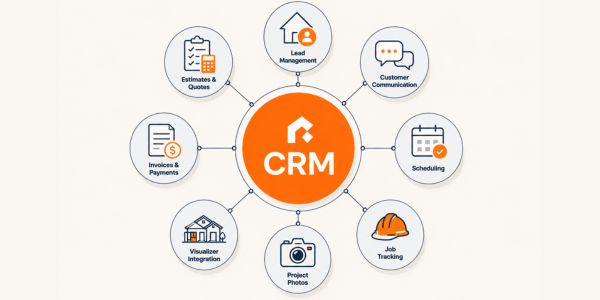
With so many CRM options available, it can be cumbersome to evaluate the best one for your business. In his article, "The 8 best CRMs for contractors and construction businesses," Miguel Jacinto of Renoworks examines how customer relationship management (CRM) platforms help contractors streamline operations, improve follow-up and better manage projects from the initial lead through project completion. The article also highlights how visualization technology like Renoworks Pro can complement CRM systems by supporting homeowner decision-making during the sales process.
As construction businesses face increasing pressure to manage leads, estimates and customer communications more efficiently, CRM platforms have evolved beyond simple contact databases. Today's contractor-focused solutions often combine sales management with estimating, scheduling, job tracking, document storage and invoicing, creating centralized systems designed specifically for construction workflows.
Miguel notes that selecting the right CRM depends largely on a company's size, business model and operational priorities. For roofing and exterior contractors, platforms such as JobNimbus emphasize mobile functionality and field-ready workflows. Home builders and remodelers may gravitate toward Buildertrend, which combines CRM capabilities with project management and financial tools. Meanwhile, Contractor Foreman offers an all-in-one solution geared toward smaller contractors seeking broad functionality at a more accessible price point.
The article also highlights specialized solutions designed to address specific business challenges. Followup CRM focuses on bid tracking and sales follow-up, while MarketSharp targets lead generation and appointment-driven remodeling businesses. Builder Prime serves exterior remodeling contractors by connecting sales and production workflows, while Jobber is positioned for smaller field service companies seeking simplicity and ease of adoption. For large-scale commercial contractors, Procore offers enterprise-level construction management capabilities with CRM functionality integrated into a broader project management platform.
According to Miguel, contractors evaluating CRM platforms should consider factors such as mobile accessibility, estimating capabilities, software integrations, pricing structures and user adoption. The goal is not necessarily to select the platform with the most features, but rather the one that aligns most closely with how a company sells, manages projects and serves customers.
The article also notes that while CRM systems can help organize and manage the sales pipeline, visualization tools such as those offered by Renoworks Pro can play an important role in helping homeowners better understand project outcomes before making purchasing decisions.
Learn more about Renoworks in their Coffee Shop directory or visit www.renoworks.com.
Recommended For You

Una mirada nueva puede ver lo que la experiencia a veces pasa por alto
Read More ...
This just in: Cyber liability insurance is here
Read More ...
6 Tips to Getting Bigger Commercial Roofing Jobs
Read More ...





Comments
Leave a Reply
Have an account? Login to leave a comment!
Sign In