











Moving beyond outdated R-value testing for below-grade applications
By Michael Rhodes, Polyisocyanurate Insulation Manufacturers Association (PIMA).
Updated testing approaches are helping contractors and designers make more informed insulation decisions.
Accurately evaluating insulation performance in below-grade environments has long been a challenge for the construction industry. According to the Polyisocyanurate Insulation Manufacturers Association (PIMA), traditional testing methods often rely on short-term moisture exposure followed by drying periods, which do not reflect the persistent damp conditions insulation faces below grade. Factors such as soil saturation, hydrostatic pressure and freeze-thaw cycles introduce sustained moisture exposure that far exceeds the scope of conventional lab testing.
As a result, many long-standing assumptions about insulation performance are rooted in outdated data and legacy testing protocols. PIMA highlights that earlier studies, often focused on limited polystyrene materials, fail to represent today’s broader range of insulation products or modern material formulations. This gap has led to a growing need for more realistic performance metrics that better align with real-world conditions and provide design professionals with clearer guidance when specifying below-grade insulation systems.
Why is RBG a more realistic metric for below grade applications?
R-value is a standardized metric used to report a material’s resistance to heat flow — a higher R-value means greater insulating effectiveness. Several factors influence an insulation’s R-value, including where it is installed. While above grade applications can face variable conditions, below-grade applications will almost certainly be exposed to consistent and high levels of relative humidity with minimal drying potential. For this reason, below-grade thermal resistance (RBG), which refers to the R-value of an insulation product after a 28-day simulated moisture exposure, more accurately characterizes how an insulation material may perform when placed in these conditions.
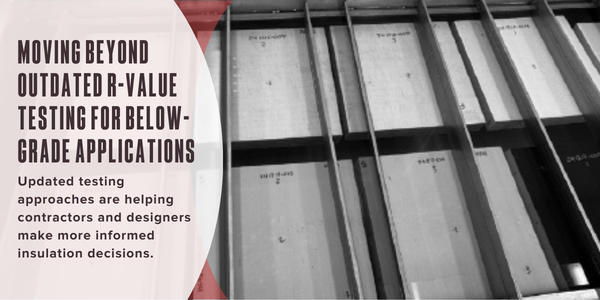
Recently, PIMA completed a research study with a third-party laboratory to examine the impacts of prolonged moisture exposure on the R-value of polyiso continuous insulation (polyiso CI), EPS insulation and extruded polystyrene (XPS) insulation. The research protocol used a modified ASTM D2842 water absorption test (submersion period extended to 28 days) and a modified ASTM C518 thermal resistance test (materials tested in a wet condition inside heat flow meter).
Following the 28-day water submersion period and without drying time (as described in PIMA Technical Bulletin #603), polyiso CI retained 95 percent of its labeled R-value demonstrating reliable thermal performance in simulated below-grade conditions. Most notably, polyiso CI performed significantly better than EPS under identical independent third-party laboratory test conditions and produced comparable RBG values to XPS. These results reinforce the need to assess insulation materials intended for prolonged below-grade exposures under extended moisture conditioning scenarios.
Which testing standards reflect moisture-exposed conditions?
Currently, commonly used test methods that examine the thermal performance of insulation material do not quantify the impacts of moisture exposure on R-value. Even standards like ASCE 32 (Design and Construction of Frost-Protected Shallow Foundations) do not describe how users should quantify the thermal performance of insulation materials after moisture exposure. Instead, ASCE 32 only includes assumed R-values for polystyrene insulation products that are derived from the historical testing mentioned above and based on prior generation product types.
Given this gap in test methods, PIMA undertook its research project to examine how today’s foam plastic insulation materials perform after prolonged moisture exposures. We expect the research results to help design professionals better understand insulation options for their below-grade applications. Eventually, the PIMA research could also help inform changes to standard for below-grade insulation applications like ASCE 32.
When below grade, polyisoCI comes out on top
Because dry state R-values do not fully represent real-world conditions, RBG provides a more accurate assessment of insulation materials under prolonged moisture exposure. Legacy standards do not reflect current material options or methodologies, so combining multiple ASTM test standards can quantify R-values in below-grade conditions more fairly, accurately and transparently. Under these modern methods, polyiso CI maintains its industry leading R‑value per inch in below-grade applications where moisture exposure is a critical concern.
To dive deeper into this topic, check out PIMA Technical Bulletin #603.
Original article and photo source: PIMA
Learn more about Polyisocyanurate Insulation Manufacturers Association (PIMA) in their Coffee Shop Directory or visit www.polyiso.org.
Recommended For You

Ingage Announces Exciting New Podcast
Read More ...
Top 15 things to see and do at Equip Expo 2026
Read More ...
Caution: Attic air can affect living space air
Read More ...


Comments
Leave a Reply
Have an account? Login to leave a comment!
Sign In