










4 single-ply roofing welding tips
By Versico Roofing Systems.
Get better installations with fewer cold welds with these recommendations.
When it comes to creating watertight TPO, PVC and KEE HP single-ply roof systems, the experts at Versico recommend avoiding cold welding. In general terms, cold welding is when pressure under vacuum conditions fuses metal together rather than heat as in traditional welding. This is also sometimes called cold pressure welding or contact welding.
When done purposefully in certain applications (for example electrical engineering and aviation) it can be a powerful method. But it is not the ideal method for installing a roof system and can actually cause a variety of issues with the waterproofing of that system. Keep reading for tips on how to avoid unwanted cold welding in your roofing projects!
1 – Equipment
Use proper power sources or commercial-grade generators. Generators should be rated for 3,000 watts for two hand welders, or 6,500 watts for one auto-welder. Proper extension cords are critical. For auto-welders, use a 10-gauge wire with a maximum length of 100 feet; for hand welders, use a 12-gauge wire with a maximum length of 100 feet. Welders should be in good shape, with clean air screens and a clean nozzle.
2 – Temperatures
The following are starting guidelines for temperature, speed and airflow. Settings may vary depending on membrane thickness (45-, 50-, 60- or 80-mil). Check out Versico’s TPO Welding Guide and PVC/KEE HP Welding Guide for more information.
3 – Critical welding steps
Keep in mind that ambient temperatures will affect welding temperatures and speeds, as will welding in the sun versus welding in the shade. Certain substrates can hold heat in the membrane (polyiso insulation), while others can rob the heat from the membrane (concrete).
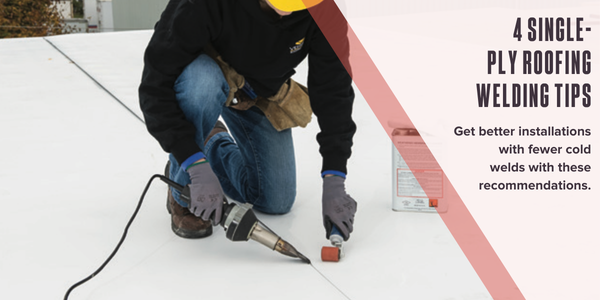
When hand welding, immediately roll across the hot seam at a 45° angle with a 2” silicone roller. This helps to ensure the top membrane is adequately pressed into the bottom membrane. When welding across a step-off, be sure to crease the top membrane into the step-off with a 2” silicone roller immediately after welding. This will help prevent a water channel from forming in the weld.
It’s important to perform test welds several times each day because of changing ambient and membrane temperatures. Simply cut a 1”-wide strip across the weld and peel to inspect the weld area. Remember to probe all seams at the end of each work day. Tip: Avoid using the edge of the roller, which can damage or cause cold welds on TPO/PVC.
4 – Cleaning and maintenance
Always clean aged or dirty membrane before welding. On PVC or KEE HP, use PVC and KEE HP Membrane Cleaner; on TPO, use Weathered Membrane Cleaner. Clean all residue from the weld area and allow it to dry before welding. Maintain your equipment before, during and after welding. Regularly inspect the silicone pressure wheels on your auto-welder and hand roller to make sure they’re not affecting the integrity of the membrane while welding or rolling. Clean the char off the heat gun nozzle using a brass wire brush and keep the intake free of debris to allow maximum airflow. On the auto-welder, adjust the nozzle to eliminate heel drag.
If you have questions, check out Versico’s TPO and PVC/KEE HP Welding Guides or contact your Field Service Representative.
Original photo and article source: Versico Roofing Systems
Learn more about Versico Roofing Systems in their Coffee Shop directory or visit www.versico.com.
Recommended For You




Comments
Leave a Reply
Have an account? Login to leave a comment!
Sign In