












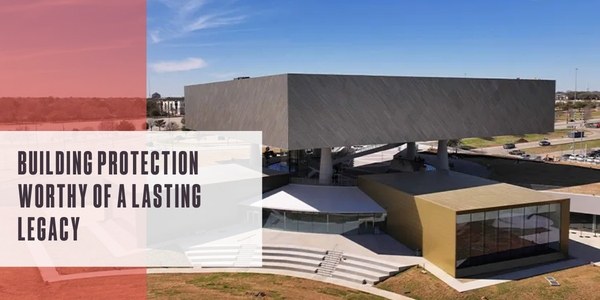
Building protection worthy of a lasting legacy
By Jesse Sanchez.
The team behind the National Medal of Honor Museum explains how collaboration, complex waterproofing and meticulous planning helped bring an ambitious architectural vision to life.
The National Medal of Honor Museum in Arlington, Texas, presents a strikingly simple architectural form, but beneath its exterior is a roofing and waterproofing system shaped by years of planning, problem-solving and collaboration. During this Coffee Conversations® webinar, Heidi J. Ellsworth spoke with Mark DeFreitas, vice president of national and strategic accounts at SOPREMA and Chris Evans, vice president of estimating for KPost Roofing & Waterproofing, about the construction challenges behind the museum. From the beginning, Chris emphasized that success depended on approaching the project collaboratively, explaining, “We weren't winning a job, we were joining a team.”
The building's elevated steel structure is supported by five pillars representing five branches of the military, while an oculus recognizes the Space Force. Creating that seemingly simple design required the team to address weight restrictions, drainage, hundreds of penetrations and extensive structural elements above the roof. Chris described the challenge of translating architectural simplicity into a buildable system, noting, “With simplicity often comes complexity below and that's kind of what we got the benefit to try to work out and figure out.”
As the roofing design evolved, KPost installed a tapered lightweight insulating concrete assembly to establish drainage across the flat structure while working around more than 280 penetrations. Multiple roofing layers followed, along with DTEC Primer to support electronic leak detection before the completed roof was concealed beneath the building's exterior panels. The final assembly also included a reinforced ALSAN RS liquid-applied system, which allowed crews to address challenging transitions, flashing conditions and unique penetrations.
Quality control remained central throughout construction. Testing was completed before panel installation advanced, helping the team verify the continuity of the waterproofing system before it became inaccessible. Mark highlighted the importance of that long-term responsibility, observing, “I call this a reputational project.” For the manufacturers, contractors, consultants and installers involved, the work represented more than completing another commercial roof, it meant creating a system expected to protect the museum and its contents long after construction ended.
The project ultimately demonstrated how technical expertise, communication and strong relationships can turn a demanding architectural concept into a coordinated construction effort. From material logistics and technical support to safety, testing and trade coordination, each part of the process contributed to a roof designed to remain out of sight while performing an essential role.
Listen to the podcast or Watch the conversation to learn more about the collaboration, roofing system and technical problem-solving behind the National Medal of Honor Museum!
Learn more about SOPREMA in their Coffee Shop Directory or visit www.soprema.com/us.
About the author

Jesse is a writer for The Coffee Shops. When he is not writing and learning about the roofing industry, he can be found powerlifting, playing saxophone or reading a good book.
Recommended For You

Protecting company culture during growth
Read More ...
The Growing Popularity of Rollforming Machines
Read More ...
Why metal cladding testing starts long before installation
Read More ...





Comments
Leave a Reply
Have an account? Login to leave a comment!
Sign In