












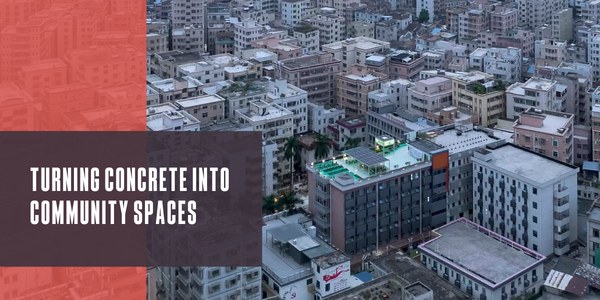
Turning concrete into community spaces
By Emma Peterson.
How rooftop gardens are transforming Shēnzhèn’s rooftops into meaningful and sustainable public spaces.
Just north of Hong Kong along the coast of the South China Sea sits a city called 深圳 (Shēnzhèn). A part of the 广东 (Guǎngdōng) province, for much of modern history, Shēnzhèn has been a small border city with around 30,000 inhabitants. However, in 1979, it was declared a special economic zone and opened to foreign investment and business. Subsequently, the city has grown rapidly. In a 2022 article for Urban Science, Xunyu Zhang, Dongxu Pan, Kapo Wong and Yuanzhi Zhang described this growth:
Over the course of only 40 years, Shenzhen, China’s first Special Economic Zone, has become a megacity, exhibiting an explosive growth from 0.31 million to 17.56 million permanent residents, a 55-fold increase within the span of four decades. Shenzhen, which is the only city in China with an urbanization rate of 100%, retains about 50% of the ecological control line, severely limiting the amount of developable urban land.
In other words, the city has grown incredibly rapidly, but also with limited space as government regulation requires that 50% of its land be set aside and left undeveloped to “function as green lungs.”
Due to this requirement, the city has had to turn to innovative ways to create public spaces and amenities. One such innovative solution was the use of rooftops as public spaces. Specifically, through the 共建花園 (Gòngjiàn Huāyuán) initiative, known in English as We Garden, the city has developed multiple community gardens on roofs around Shēnzhèn.
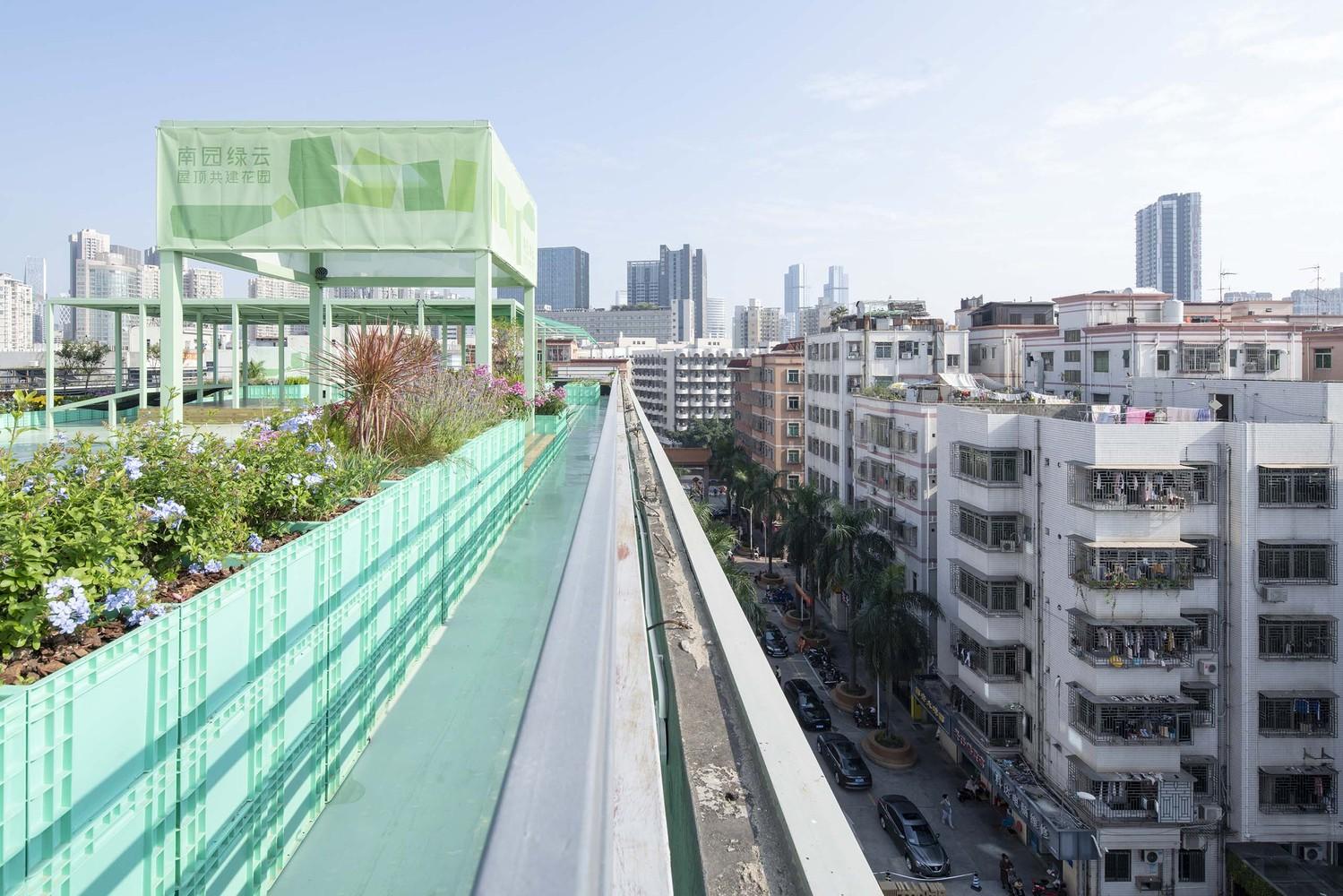 The Boonself Apartments garden
One of the roofs is located in the 南山 (Nánshān) district, specifically on top of the 邦舍青年 (Bāngshě Qīngnián) apartments. These apartments, known as the Boonself Apartments in English, faced unique challenges due to the project’s limited space, budget constraints and building restrictions.
To overcome these challenges, many organizations, such as the Shenzhen Green Foundation, The Nature Conservancy, 11architecture, Shenzhen New Energy Association, American Polar Airlines and the Nanshan Urban Management and Law Enforcement Bureau worked together to find solutions. These solutions were:
- Careful project planning from 11architecture in combination with the use of 708 modular standard logistics units allowed for the optimization of space
- Investments from organizations brought in additional funds. For example, “American Polar Airlines contributed by investing in the construction of the community farm, enhancing urban environmental protection and greening efforts.”
- Solar panels were installed on top of the planned sunshade canopy in order to help meet the city of Shēnzhèn’s low-carbon objectives, making building approvals easier.
The resulting space measures 450 square meters and “hosts various activities like rental farms, events and community gatherings.”
The Gangxia Village garden
Another one of these rooftop gardens is located in the 福田 (Fútián) district in the 岗厦 (Gǎngxià) village. Gǎngxià is considered an “urban village.” Vivin Qiang and Xin Yu describe these areas in an article for the Nature Conservancy:
Urban villages used to be ‘real’ villages, but rapid development has turned the farmland that once surrounded them into high rise buildings. [They] are characterized by their dense living conditions, where resident buildings are built so close together that neighbors can shake hands with one another from their windows. Inside the villages, the streets are filled with markets, restaurants and shops, making people’s lives convenient. However, very few green spaces, such as parks or gardens, exist inside the villages.
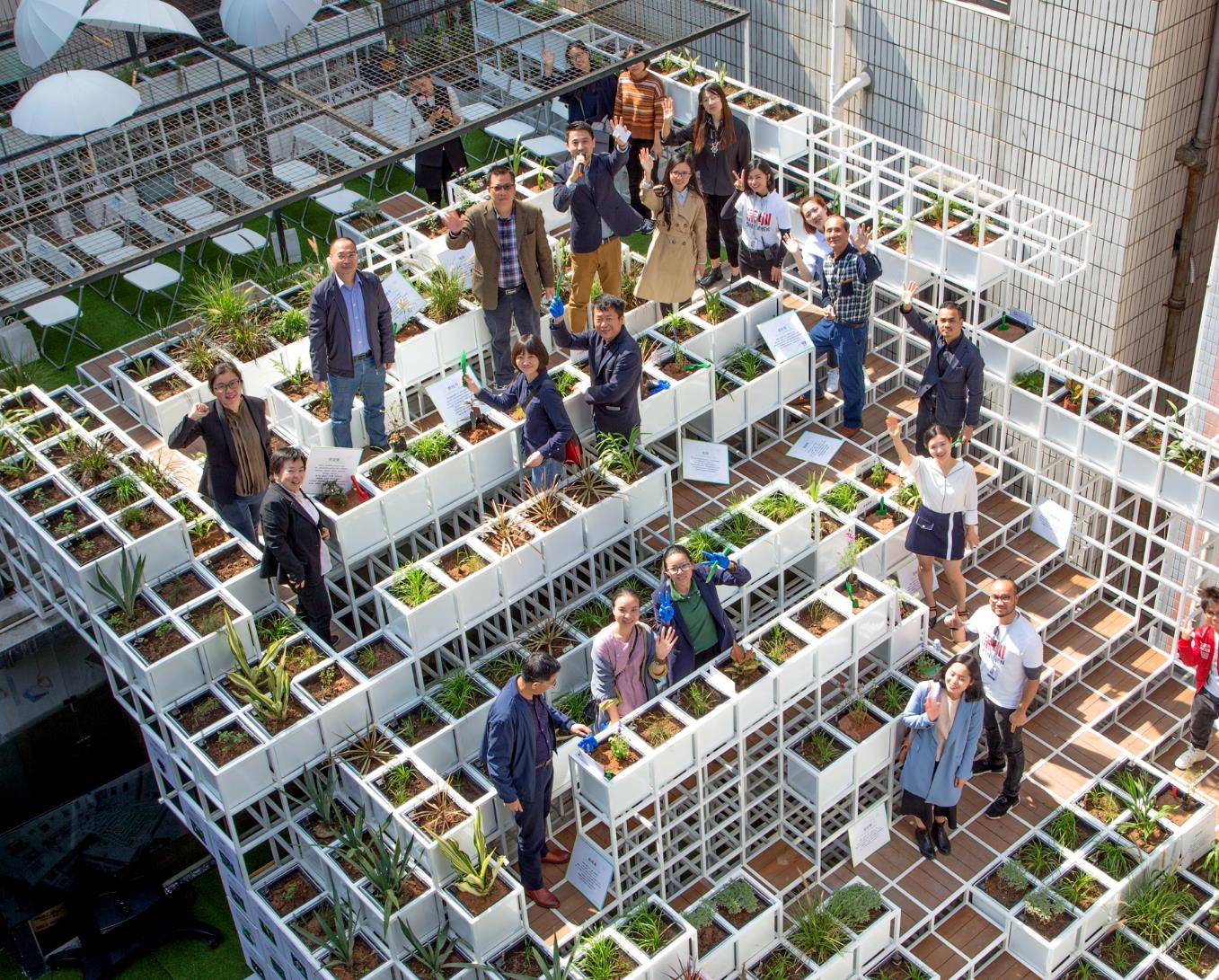 This lack of green spaces not only creates a lack of community gathering locations, but it also leads to ecological issues like flooding due to lack of proper drainage. To address both of these issues at once, The Nature Conservancy and other partner organizations transformed an old rooftop in Gǎngxià into a green roof.
Today, the rooftop holds over 420 plant containers filled with native plants and acts as a community space where musical concerts can be hosted and youth can take classes relating to nature and conservation. Additionally, the garden space has created “a nature-based stormwater management system for the residential building, achieving a 65% o frun-off control rate.”
As Vivin and Xin Yu put it, "The green roof not only serves as a sponge for rainwater, but it is also a sponge for community engagement, education and culture.”
Beyond Shēnzhèn
The development of these gardens in Shēnzhèn showcases the value of rooftop spaces in densely populated metropolises. As Anton Giuroiu wrote in an article for ArchitectureLab, “When thoughtfully designed, [publicly accessible rooftop spaces] can serve as an attractive venue for walking and various activities, while also fostering a sense of community.” Further, in light of climate change impacts, these rooftop gardens also provide “an effective strategy to mitigate the urban heat island effect and contributes to building low-carbon cities.”
Overall, Shēnzhèn and the rooftop gardens built through the We Garden initiative are a prime example of how urban areas can support community and sustainability at the same time. As Anton put it, “[These projects] embod[y] a new type of community space by integrating the concepts of ‘Green Roof (low carbon)’ and ‘Co-build Garden (community activities).’”
Original image sources in order of appearance: ArchitectureLab, The Nature of Cities, ArchitectureLab, The Nature of Cities
About the author

Emma is the senior content developer at The Coffee Shops and AskARoofer™. When she's not working or overthinking everything a little bit, she enjoys watching movies with friends, attending concerts and trying to cook new recipes.
Recommended For You

The Roofing Alliance Approves Funding for Sustainability and Resiliency Research
Read More ...
How long until this roof becomes carbon neutral?
Read More ...
Solar panels + Synthetic roofing = Great homeowner savings
Read More ...





Comments
Leave a Reply
Have an account? Login to leave a comment!
Sign In