









Tomorrow’s workforce starts with today’s industry connections
By The Coffee Shops®.
Your industry’s next generation is in today’s classrooms — help students discover what’s possible by connecting with local schools and CTSO programs.
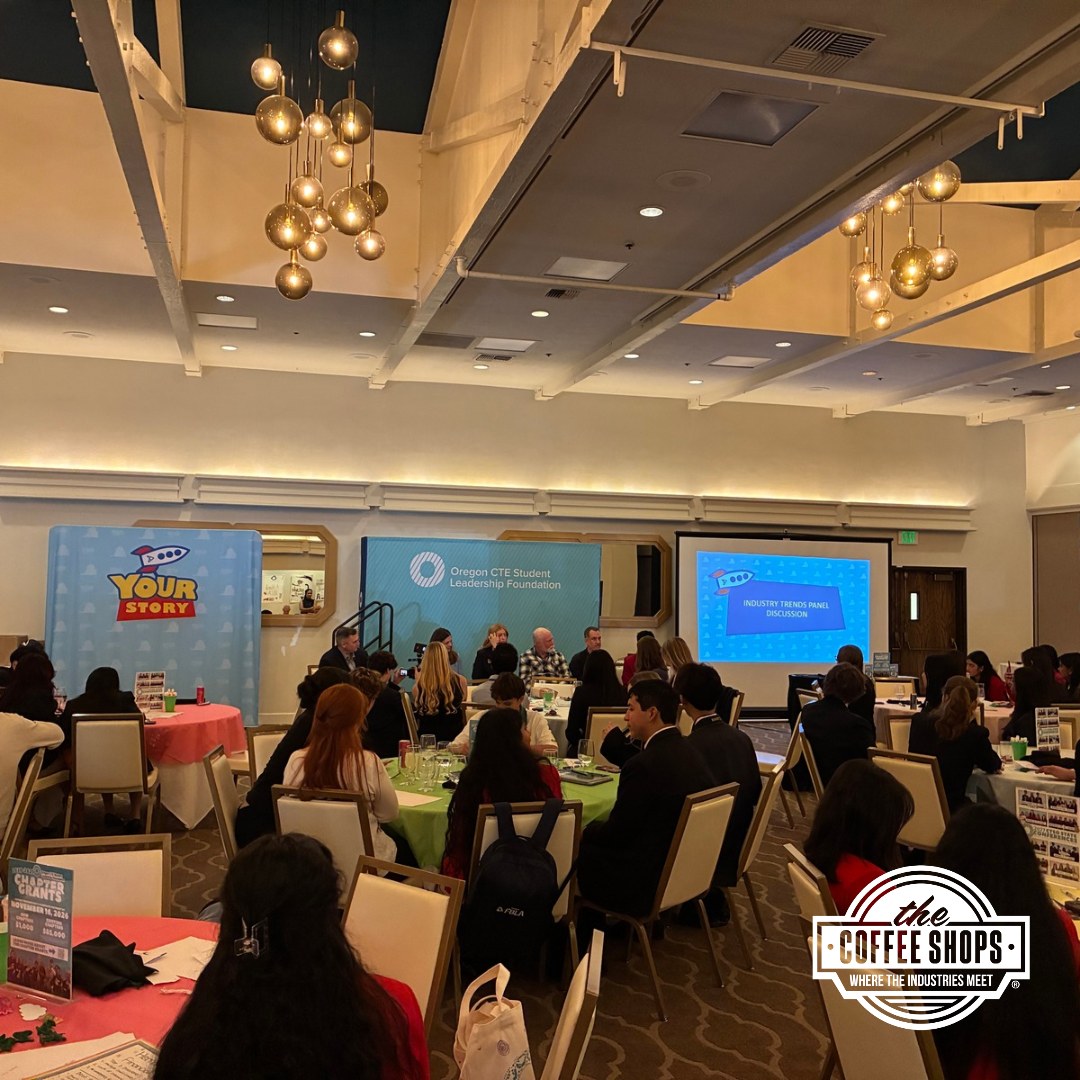
During the Oregon CTSO Academy for Chapter Excellence Conference in Ashland, Oregon, on October 8-10, an industry trends panel discussion was hosted that focused on the transition from education to employment. Moderated by Chuck Young, the director of Oregon SkillsUSA, the discussion was eye opening. The panel comprised of Saai Grandhi, SkillsUSA Oregon treasurer; Mari Yonan, DECA vice president of leadership; Rep. Emily McIntire; Jared Rennie, owner of Noble Coffee; Brent Kell, CEO of Valley Immediate Care.
Overall, it was identified that Oregon students need more opportunities to explore careers early, develop practical skills and connect directly with employers. Throughout the conversation, panelists returned to a central idea: a student’s first career decision should be informed by real-world experience. Internships, externships, job shadows and classroom visits from industry professionals can help students understand a field’s responsibilities, pay, schedule and quality of life before investing significant time and resources in it.
That exploration does not mean students must commit to one career for life. Instead, it gives them an opportunity to learn about themselves, identify their interests and make their next decision with greater confidence. “Try a bunch of different things, then choose one and get really, really good at it,” Jared said.
Finding purpose through early career exploration
Panelists encouraged students to explore several industries in low-risk, high-growth environments. Career and technical student organizations (CTSOs), school programs and industry partnerships can give students a closer look at possible career pathways while helping them build practical experience.
Students on the panel emphasized the importance of understanding their own interests and motivations. Once students identify a passion, they said, they need the drive to pursue it through education, employment or another pathway.
Exposure should begin well before graduation. One panelist noted that students may begin forming ideas about careers as early as elementary school, making middle school and the earlier grades important times to introduce a variety of career clusters.
Saai shared an example about a Chromebook repair program at his school where they partner with Acer, the company that makes the Chromebooks and students repair the devices for their district, gaining technical experience and discovering whether they enjoy the field or not. That experience can strengthen a résumé and potentially lead to an internship or future employment.
Panelists also discussed the need to present options beyond a traditional four-year college path. Businesses could visit schools in much the same way colleges do, explaining what they do, what opportunities they offer and which skills students need to succeed.
Building skills that carry across careers
Career readiness requires more than technical knowledge. Panelists identified writing, spelling, email etiquette, communication, punctuality, time management and perseverance as foundational workplace skills.
They also encouraged students to develop the courage to ask questions, take an unfamiliar path and continue when work becomes difficult. “You have to show up and you have to do hard things,” Brent said. “If you show up and do hard stuff. You’re going to succeed.”
Failure was consistently presented as part of growth rather than a final outcome. Students were encouraged to recover quickly, learn from setbacks and keep moving forward. One panelist summarized the goal as learning how to learn. Industries, technologies and individual career paths will continue to change, but students who know how to acquire new skills will be better prepared to adapt.
“No one’s path looks the same,” Emily shared. “Learn how to learn and then don’t stop.”
Creating stronger relationships with industry
The panel also explored how to bring industry partners into the classroom. Suggestions included inviting business professionals to speak with students, creating advisory boards, developing student-led projects and providing regular opportunities to visit workplaces. “People want to hear from industry professionals,” Mari said. “People want to hear about things that aren’t just a four-year university.”
Local chambers of commerce can help schools identify nearby businesses interested in supporting students. School administrators, superintendents and school boards can also help establish partnerships and create pathways between classrooms and workplaces.
Panelists acknowledged that reaching out can be difficult. Teachers may not always know whom to contact, while small and midsized employers may be too busy to build an internship or job-shadowing program from the ground up.
Employers may be more likely to participate when schools make the opportunity specific and manageable. Instead of asking a business to design an entire program, an adviser could present a student who is interested in a particular field, explain the student’s availability and ask the employer to provide a defined experience. “If we just have to show up for these kids, it’s so much easier for us,” Brent said.
Making education relevant to the future of work
Panelists called for deeper collaboration between schools and businesses at the curriculum level. Because many industries change quickly, employers can help educators understand which skills students will need when they enter the workforce.
At the same time, education must continue to provide strong foundations in math, science, reading and communication. Students should leave school equipped to pursue their goals and be able to demonstrate meaningful knowledge and skills.
Hands-on learning can connect those academic foundations to a clear purpose. Career and technical education programs give students opportunities to apply what they are learning while discovering where their interests may lead.
For industry professionals, building the next generation of talent starts with making a connection. Reach out to a local school or CTSO adviser and ask how your experience, time and resources can support students exploring their futures. Whether you speak to a class, offer a job-shadowing opportunity or donate materials for hands-on learning, your involvement can help students connect classroom lessons with real career possibilities – students are eager for real-world experiences. You do not have to build an entire program to make a difference — start with one conversation, one classroom or one student and help open the door to a future in your industry.
Learn more about SkillsUSA in their Coffee Shop Directory or on skillsusa.org.
Recommended For You

Awards, Scholarship Winners and Education Content at NWiR Day 2021
Read More ...
Hands-on training strengthens installation confidence
Read More ...
Dust off your cowboy hat, lace up your boots and head to Arizona this October
Read More ...




Comments
Leave a Reply
Have an account? Login to leave a comment!
Sign In