









From finding roof damage to fixing it
By Karen L. Edwards.
Oak Ridge researchers are looking beyond automated inspection to a future where coordinated robots could help perform roofing tasks and repairs.
Imagine a roof inspection following a major storm. A system scans the roof, identifies the location of a membrane tear and determines what needs to be fixed. Then another machine goes to that location and performs the repair.
That isn't something roofing contractors are likely to encounter tomorrow, but researchers at Oak Ridge National Laboratory are beginning to investigate technologies that could eventually connect automated roof inspection with robotic construction and repair.
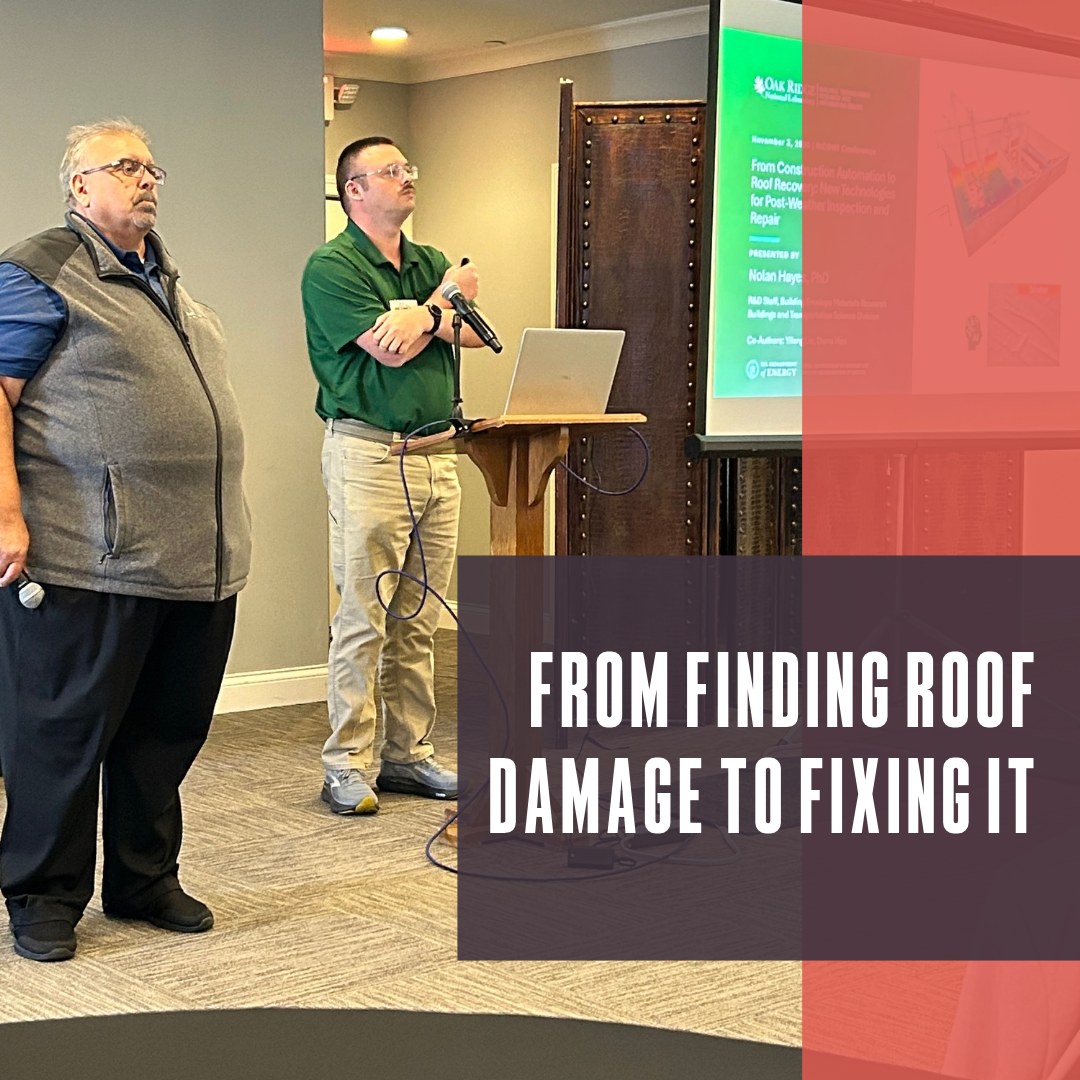
During the 2026 RICOWI Fall Seminar, Dr. Nolan Hayes explained that Oak Ridge's automated inspection technology is considerably further along than its robotic roofing research. The robotics research is still in its early stages. But it offers a glimpse of where construction automation could eventually lead.
Why roofing is challenging for robots
Installing shingles may appear repetitive, but successfully automating the process is anything but simple. Each shingle must be moved into position, aligned correctly with the surrounding materials and properly fastened. The process repeats across individual courses while workers navigate the roof and coordinate with each other.
Existing robotic systems have already demonstrated that portions of the process can be automated. Nolan referenced work by Renovate Robotics, which has developed robotic approaches for installing shingles.
But automating a roofing task isn't enough. The robotic system also has to perform fast enough to make automation practical. That is where Oak Ridge researchers are approaching the problem somewhat differently.
Don't just make one robot faster
Nolan believes the answer may be collaboration. A human roofing crew doesn't rely on one worker to install an entire roof alone. Multiple people divide the work, adjust their activities and respond to what other crew members are doing.
Why shouldn't robots work the same way?
Oak Ridge is researching a multi-robot system in which several robots could perform installation tasks simultaneously. But having multiple machines on a roof creates another challenge. Someone, or something, needs to coordinate them.

Giving the robotic crew a central brain
The researchers envision what Dr. Hayes described as an orchestrator, essentially an AI-driven central brain that understands the roofing process and communicates instructions to each robot.
Consider three robots installing shingles on separate courses. If the first robot runs out of shingles and leaves its position to retrieve more, the other two robots might eventually catch up. Without coordination, they could be forced to stop and wait for the first robot to return.
Humans naturally recognize that problem and adjust. Robots need to be told. An orchestrator could recognize that the first robot has left its course, reassign the second and third robots and then give the returning robot a new task when it comes back with additional shingles.
The important advancement, Dr. Hayes explained, may therefore come from collaboration rather than simply building faster robots. Reducing downtime across the robotic crew could improve the speed and economics of the overall system.
From installation to storm response
The technology becomes particularly intriguing when combined with automated roof inspection. Following a severe weather event, an automated inspection system could potentially collect information about the roof and identify specific areas and types of damage.
If a robot were trained to perform the steps necessary to repair that particular damage, inspection and repair could eventually become parts of the same automated workflow. “If you combine that automated roof inspection with this robotic system, you could send a robot on the roof,” Dr. Hayes said.
The robot could search for particular damage and potentially perform the required task. The concept could expand to multiple robots simultaneously identifying or responding to different problems on the same roof.
A tool for tomorrow's roofing workforce
None of this means today's roofing crew is about to be replaced by robots. Dr. Hayes was careful to describe automated roof repair as forward-looking research. The inspection technologies he presented are significantly closer to practical application than coordinated robotic repairs.
But the research raises an important question about construction automation. Instead of asking whether one robot can work as quickly as one person, perhaps the better question is how an entire automated system can work together.
That means teaching machines more than how to carry a shingle, place it or drive a fastener. They also need to understand the sequence of work, recognize when conditions change and coordinate their actions with the rest of the crew. That's what experienced roofing crews already do every day.
If researchers can successfully teach robotic systems to do the same, the future of roof automation may not be one robot working alone. It may look a lot more like a crew.
Learn more about RICOWI in their Coffee Shop directory or visit www.ricowi.com.
About the author

Karen L. Edwards is the COO at RoofersCoffeeShop and a marketing consultant and freelance writer for the roofing industry. When she is not working, she is watching or attending sporting events, listening to music and spending time with family.
Recommended For You
ServiceTitan previews AI-powered future for roofing contractors at Pantheon
Read More ...
Create “Ingaging” Presentations to Retain Clients
Read More ...
Revenue Grows 433% After This Company Starts Using Software
Read More ...






Comments
Leave a Reply
Have an account? Login to leave a comment!
Sign In