



Don’t build a bigger job for yourself: Build a better roofing business
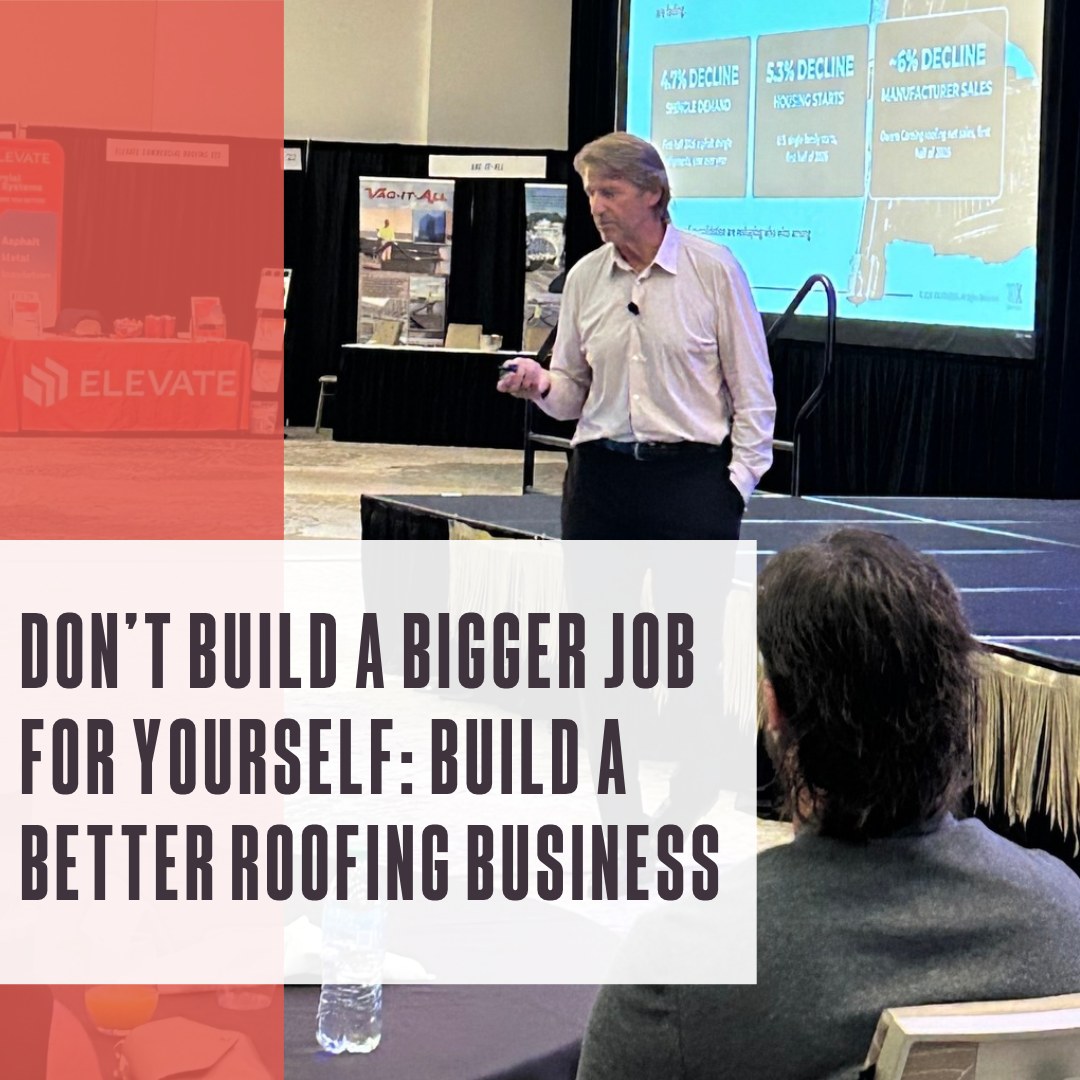
By Karen L. Edwards.
Being a great roofer and building a great roofing business requires different skills.
Greg Bolt of 10X Roofing spoke to attendees at the 2026 MRCA Leadership summit, explaining why systems, leadership and financial discipline are critical to scaling successfully. Greg learned about accountability in roofing at an early age.
At 16, after spending a morning installing shingles, his uncle inspected the work. The shingles looked good, but they were running downhill. His uncle handed him a shingle bar and told him to carefully remove the shingles, save the nails and come back the next day to reinstall everything correctly.
“The client isn't going to pay for your mistakes. The company isn't going to pay for your mistakes,” his uncle told him. “You're going to learn today.”
It was an early lesson about craftsmanship and responsibility. But during nearly five decades in roofing, Greg learned another important lesson: Knowing how to do the work well doesn't mean you know how to build a business.
When the system that got you here stops working
Greg's family roofing company was doing about $1 million in revenue when he came out of college. By 2004, the company was still around $3 million, a revenue level it struggled to move beyond for years.
The problem wasn't roofing expertise. Greg described the company's model as “cradle to grave.” He estimated the job, sold it, managed it, finished it and collected the money. That system worked for a smaller contractor, but it wasn't scalable. “The system that got me there isn't the system that got me to $20 million,” he said.
That lesson becomes even more important when the roofing market tightens. Increased demand can sometimes disguise operational weaknesses. When demand becomes less predictable, those weaknesses become easier to see.
Rather than relying on the market to deliver growth, contractors need to focus on what they can control inside their companies.
Revenue doesn't tell the whole story
A roofing company can increase revenue while simultaneously becoming harder to manage, less predictable and more dependent on its owner. For growth to be sustainable, the company's infrastructure must grow with its revenue.
Greg identified several common constraints that emerge as roofing businesses expand, including owner dependency, inconsistent hiring and training, unpredictable marketing and sales, operational challenges and a lack of financial visibility.
Finance, he said, is an especially common weakness. Contractors may know how to sell and install roofs but lack a clear view of job costs, overhead, margins and other factors driving profitability.
Those challenges don't necessarily mean the business is failing. They may indicate that the company has simply outgrown its current way of operating.
Could your company handle twice the work?
Greg offered contractors a simple question to test whether their businesses are truly scalable: If your revenue doubled, could your current people and systems handle the additional work?
Every stage of growth exposes new limitations. Scheduling, communication, job oversight and financial reporting may all become harder as companies add employees, crews and projects.
Instead of immediately asking how to generate more sales, Greg recommends first determining what could prevent the company from successfully handling those sales.
A problem appearing in production might actually have originated in sales, staffing or planning. Finding those constraints early gives contractors an opportunity to strengthen the operation before more volume magnifies the problem.

The building blocks of a scalable business
Greg identifies 10 elements that need to mature as a roofing business grows: strategy, marketing, sales, people, operations, finance, leadership, data and reporting, technology and investment planning.
Strategy played an important role in his own company's transformation. Rather than continuing to offer a long list of services, the company examined which areas were most profitable and placed greater emphasis on commercial reroofing and service and maintenance.
Greg also organizes the fundamentals into what 10X Roofing calls four pillars: people, operations, finance and marketing.
People need clearly defined roles, training and accountability. Operations require documented, repeatable processes. Finance should provide visibility into profitability, cash flow and job performance. Marketing must create reliable ways to attract, convert and retain customers.
Customer retention became particularly important in Greg's own company through service and maintenance. What began with a roughly $400,000 target eventually grew to approximately $5 million in recurring revenue as the overall company reached $25 million.
Instead of installing a roof and hoping to see the customer again in 20 years, maintenance programs created continuing relationships and more predictable revenue.
From operator to founder
Greg describes a contractor's evolution in three stages: operator, owner and founder.
At the operator stage, the owner may be the company's best salesperson, estimator and problem-solver. But as the company grows, that dependence on one person eventually becomes a limitation.
Moving to the next stage requires documenting processes, developing leaders and giving employees clear responsibilities.
“Delegation means transferring responsibility and decision-making authority, not just simply giving more tasks,” Greg said.
Employees need clear targets, expectations and authority to make decisions. Greg recommends creating accountability through regular communication and measurable key performance indicators, such as leads, close rates, gross profit and cash collected.
The goal is for problems to be solved by the organization rather than continually escalating to the owner.
“As the company grows, the founder must spend less time personally managing and work more and more at building the organization that manages the company,” he said.
Building a business with long-term value
Creating that independence doesn't just make daily operations easier. It can also increase the long-term value of the business.
As consolidation continues in roofing, Greg pointed out that potential buyers and strategic partners look beyond revenue. They want to understand the company's financial performance, leadership, succession planning and operational systems.
If the owner leaves, can the business continue performing? Strong leadership, reliable financial reporting and documented systems make the company's performance more repeatable and less dependent on a single person. That creates options whether an owner intends to grow independently, pass the business to the next generation or eventually sell.
“The more valuable business is built through years of operational discipline, not just preparations immediately before the exit,” Greg said.
Contractors don't need to change everything at once. Greg recommends starting by identifying the biggest constraint preventing the company from reaching its next stage.
Because sustainable growth isn't simply about selling more roofs.
As Greg put it, “Don't build a bigger job for yourself. Build a better business.”
Learn more about Midwest Roofing Contractors Association (MRCA) in their Coffee Shop Directory or visit www.mrca.org.
About the author

Karen L. Edwards is the COO at RoofersCoffeeShop and a marketing consultant and freelance writer for the roofing industry. When she is not working, she is watching or attending sporting events, listening to music and spending time with family.
Recommended For You
Choosing a CRM that grows with your roofing business
Read More ...
10 committees to join to get the most out of your ARCA membership
Read More ...
Size Doesn’t Matter – Excellence Does
Read More ...



Comments
Leave a Reply
Have an account? Login to leave a comment!
Sign In