





Building wildfire resilience from the roof down
By The Coffee Shops™.
Reducing ignition risks by specifying roof assemblies that meet Wildland-Urban Interface requirements.
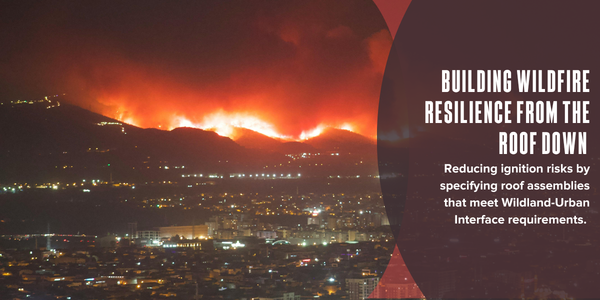
As wildfire risks increase across the United States, contractors must consider how roofing materials, complete assemblies and installation practices contribute to building resilience. In this article, Polyglass highlights that in Wildland-Urban Interface (WUI) areas, where development meets undeveloped vegetation, roofs can be exposed to wind-driven embers, radiant heat and spreading flames.
Fire-resistant roofing is not the same as fire-proof roofing. No roof is completely immune to fire. Instead, fire-resistant materials and assemblies are tested to withstand defined levels of external fire exposure. Contractors should look for systems classified under UL 790 or ASTM E108 and verify that the entire assembly meets applicable requirements.
A Class A fire rating provides the highest level of protection against external fire exposure, including flame spread and ember penetration. However, the classification applies to the complete tested assembly, not just the visible roof covering. Underlayments, attachments and installation details all contribute to system performance.
Polyglass addresses these challenges through Polystick XFR and Polyanchor XFR, which feature Burn-Shield Technology®. The proprietary fire-resistive layer is designed to block ignition from wind-blown embers and debris while supporting waterproofing performance on steep- and low-slope roofs.
Building codes are another important part of wildfire preparation. WUI provisions can influence material selection, installation methods and the use of combustible components. Requirements vary by jurisdiction, making it essential for contractors to review the International Building Code, International Residential Code and local amendments before specifying or installing an assembly.
Selecting tested systems and following jurisdiction-specific requirements can help contractors reduce liability, avoid rework and deliver stronger protection in wildfire-prone environments.
Learn more about Polyglass in their Coffee Shop Directory or visit www.polyglass.us.
Recommended For You
SOPREMA Storm Shelters can Protect From Extreme Weather Events
Read More ...
Some Striking Facts About Lightning
Read More ...
Contractors brace for extreme weather
Read More ...



Comments
Leave a Reply
Have an account? Login to leave a comment!
Sign In