











A new era of roof inspection
By Karen L. Edwards.
New technologies could help contractors create faster, more consistent and digitally traceable records of roof conditions.
Roof inspections provide critical information about a roof’s condition, but the process still relies heavily on the person conducting the inspection. New technologies being explored at Oak Ridge National Laboratory could help change that.
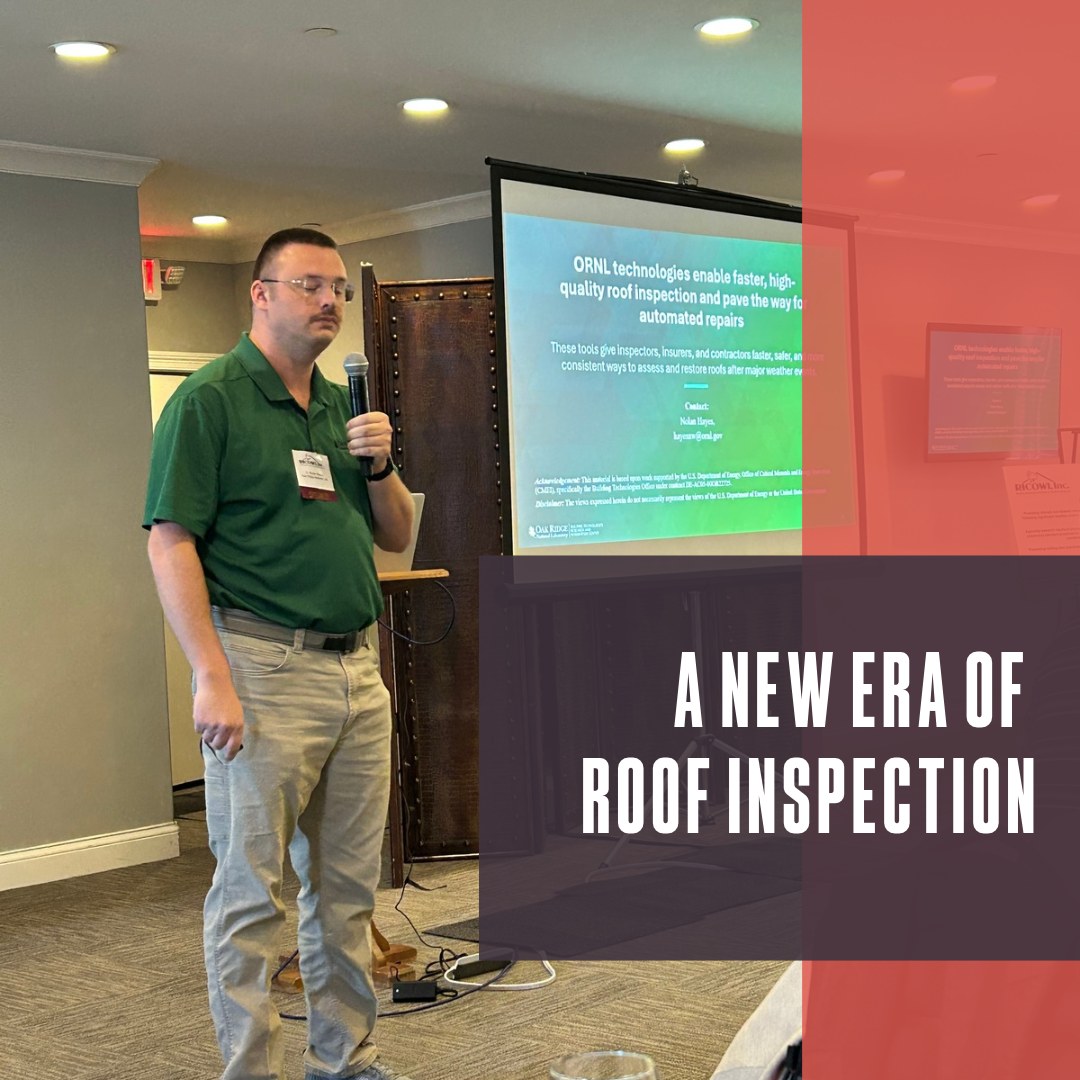
During the 2026 RICOWI Fall Seminar, Dr. Nolan Hayes, a research and development associate at Oak Ridge National Laboratory, discussed how artificial intelligence (AI), laser scanning and other technologies could make roof inspections more objective, quantifiable and digitally traceable.
Dr. Hayes has a background in construction management and engineering, with research that spans construction automation and robotics, AI-driven design, automated quality assurance, advanced materials, sensing technologies and long-term building durability. His work is focused on applying technologies already being used in other industries to construction.
Taking subjectivity out of the equation
Roof inspection is still largely a manual process. An inspector may physically walk the roof taking measurements and photographs, or a drone may be used to collect images. Either way, Dr. Hayes explained that people remain heavily involved in collecting and interpreting the information.
That introduces variability. Each inspector brings experience and judgment to an inspection, but the thoroughness of one inspection may differ from another. Documentation can vary, too.
“What you would really probably like is a way to quantify and make a digitally traceable inspection recording,” Dr. Hayes said.
Such a record could document what was observed and connect individual areas of damage with their specific locations on the roof. Dr. Hayes believes that is where the industry is heading.
Learning from French fries
One of the more unexpected examples Dr. Hayes used to illustrate the opportunity came from the food industry. Quality control in food manufacturing was once highly manual. On a French fry production line, for example, people could visually inspect fries traveling along a conveyor and manually remove the defective ones.
Modern manufacturing facilities can automate much of that process. Cameras collect images while machine learning and artificial intelligence identify products that don't meet quality standards.
Dr. Hayes sees similarities between the old manufacturing process and today's construction quality control.
Someone may still use a tape measure and checklist to verify that a building component or assembly meets specifications. Once those components reach the construction site, inspection remains heavily dependent on people.
Oak Ridge National Laboratory researchers are looking at how automated quality-control concepts can be transferred into construction. The goal is not simply automation for automation's sake. It is about collecting better information.
Creating a roof's digital record
For roofing, one of the biggest opportunities may be the ability to create a digital record of exactly what existed at the time of an inspection. Photographs, laser scans and other data could be retained and revisited later. That becomes especially valuable when conditions change.
Dr. Hayes described how scans taken at different times could potentially be compared to identify areas where a roofing membrane has deformed or degraded. Instead of relying solely on photographs or notes from a previous inspection, an inspector could compare detailed datasets from different points in the roof's life.
The same concept could have applications following severe weather. Rather than simply documenting that damage exists, digital inspection data could potentially pinpoint where the damage occurred and quantify characteristics of the roof surface.
From inspection to report
Automation could also shorten the time between collecting roof information and producing a usable report. Dr. Hayes described a future workflow in which inspectors arrive at a building, scan the roof and process the information in the field using a tablet or laptop.
Depending on the roof's size, he suggested data collection could take minutes. Automated analysis could then identify areas of concern and generate information showing where damage is located. The result could be a more consistent inspection process and faster access to information.
For roofing contractors, inspectors and insurers, the real value may be less about replacing the person inspecting a roof and more about giving that person better data. A digital roof record provides something that handwritten notes and individual observations can't always offer: a detailed picture of existing conditions that can be quantified, stored, compared and revisited.
As these technologies continue developing, roof inspection may increasingly become more than documenting what someone sees on a particular day. It could become a record of how a roof changes throughout its life.
Learn more about RICOWI in their Coffee Shop directory or visit www.ricowi.com.
About the author

Karen L. Edwards is the COO at RoofersCoffeeShop and a marketing consultant and freelance writer for the roofing industry. When she is not working, she is watching or attending sporting events, listening to music and spending time with family.
Recommended For You

How to Improve Your Ranking on Search Engine Results Pages
Read More ...
Search results page: Insert your company name here
Read More ...
What high-performing roofing crews do differently: Lessons from four decades in the field
Read More ...






Comments
Leave a Reply
Have an account? Login to leave a comment!
Sign In