








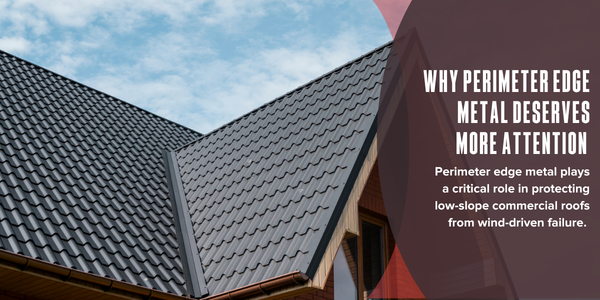
Why perimeter edge metal deserves more attention
The Coffee Shops™.
Perimeter edge metal plays a critical role in protecting low-slope commercial roofs from wind-driven failure.
When discussing commercial roofing performance, perimeter edge metal is often treated as a finishing detail. That mindset can create significant risk for contractors and building owners alike, according to Jason Hildenbrand from Carlisle Architectural Metals (CAM), parent company to Hickman Edge Systems.
During a recent episode of Roofing Road Trips®, Jason explained that perimeter edge metal is far more than an aesthetic component. It serves as a critical connection that secures roofing membranes and helps protect the entire building envelope from severe weather.
Contractors face constant pressure to complete projects efficiently while reducing labor demands and minimizing callbacks. Jason noted that perimeter edge metal can support those goals when it is considered early in the project. “Perimeter edge metal can actually help support those things, if it is handled appropriately up front and there’s a plan for it,” he explained.
The stakes are high because perimeter failures often trigger much larger roofing problems. Jason pointed to industry data showing that edge-related failures account for a significant percentage of weather-related roof damage. “It is a big piece of it,” Jason said. “If the perimeter metal fails, the rest of the roofing components cannot withstand the pressures from wind and storms and other weather events and that leads to subsequent failure.”
Building code reflects that importance. Jason explained that ANSI/SPRI/FM 4435/ES-1 establishes testing requirements for perimeter edge metal systems like fascia and coping, while ANSI/SPRI GT-1 addresses gutter systems that terminate or secure roofing membranes. Together, these standards help verify that perimeter edge components are designed to resist project-specific wind pressures.
For applicable low-slope commercial roof systems, compliance is not optional. “It’s required for every building,” Jason said. Understanding those requirements is a foundational step in delivering a high-performing roof system.
Listen to the full podcast or Watch the recording to learn more about perimeter edge metal performance and code compliance.
Learn more about Hickman Edge Systems in their Coffee Shop Directory or visit www.hickmanedgesystems.com.
Recommended For You

Five modern marketing recommendations
Read More ...
The business case for smarter construction recycling
Read More ...
Fostering customer loyalty
Read More ...




Comments
Leave a Reply
Have an account? Login to leave a comment!
Sign In