











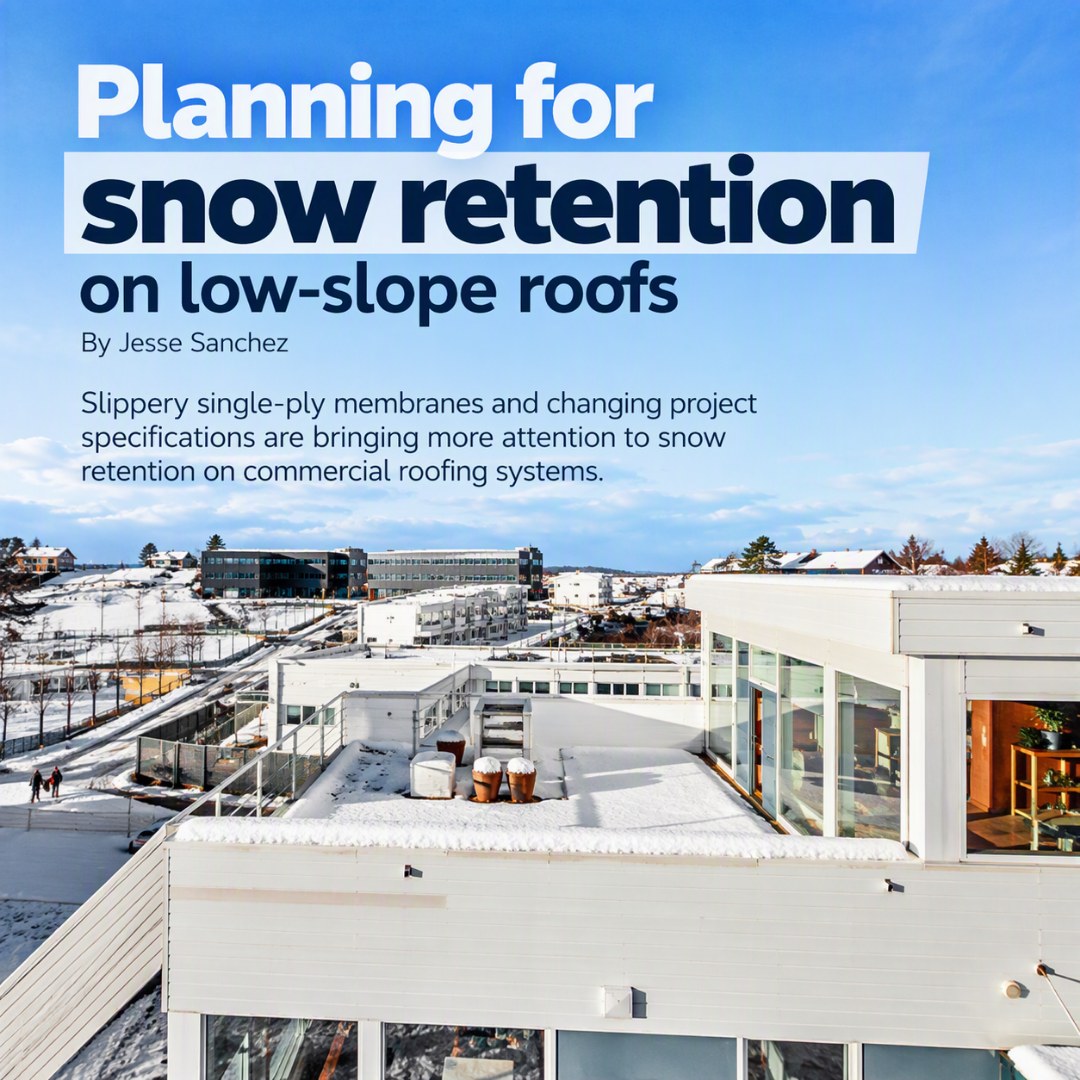
Planning for snow retention on low-slope roofs
By Jesse Sanchez.
Slippery single-ply membranes and changing project specifications are bringing more attention to snow retention on commercial roofing systems.
Snow retention is often associated with steep-slope residential roofing, but low-slope commercial roofs can face similar risks when snow and ice begin to move. On this episode of Roofing Road Trips®, host Karen Edwards spoke with Robert Alvarez, representative for Anchor Products, about why contractors and building owners should consider how snow leaves a commercial roof.
Snow guards and snow fences are designed to keep snow and ice on the roof so they can melt or leave in a more controlled amount instead of shedding in a large mass. Explaining the purpose of these systems, Robert shared, “It’s going to hold ice and snow up on a roof, so it comes down in a more measured manner.”
That consideration can be particularly important on single-ply roofing systems, including thermoplastic polyolefin (TPO), polyvinyl chloride (PVC) and ketone ethylene ester (KEE), which Robert described as especially slippery. Even roofs with minimal slope can experience sliding snow, and Robert emphasized that significant accumulation is not always necessary to create a concern. He noted, “You can have a snowfall that’s very minor and still needs snow retention. Even with a low pitch, that stuff will still slide off.”
Although there is no universal code requiring snow retention, Robert said some municipalities are beginning to include it in project requirements. Building owners must also consider what can happen below the roof when snow or ice sheds onto people, vehicles or equipment. Robert cautioned, “The liability is on the building owner.”
Designing a snow retention system begins with understanding the conditions of the individual project. Anchor Products considers factors including eave-to-ridge dimensions, roof pitch and local snow loads when determining appropriate spacing for brackets and anchors. Its commercial options include a two-pipe snow fence system as well as a unitized system for smaller areas requiring spot retention.
For contractors, understanding how membrane type, roof slope and snow load influence snow movement can help make snow retention part of the planning process rather than a response to unexpected shedding.
Learn more about Anchor Products in their Coffee Shop Directory or visit www.anchorp.com.
About the author

Jesse is a writer for The Coffee Shops. When he is not writing and learning about the roofing industry, he can be found powerlifting, playing saxophone or reading a good book.
Recommended For You
Looking beyond the roof: The case for retrofit
Read More ...
Can the building envelope be too tight?
Read More ...
Finding the path to roofing
Read More ...





Comments
Leave a Reply
Have an account? Login to leave a comment!
Sign In