












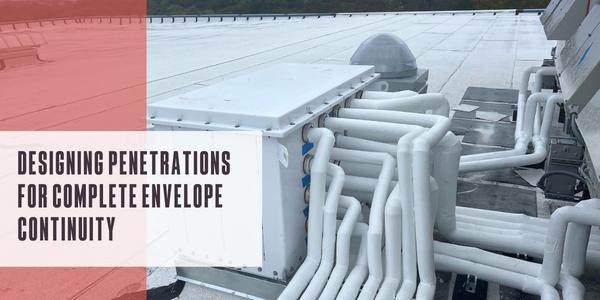
Designing penetrations for complete envelope continuity
By Jesse Sanchez.
Successful penetration details account for air, water, vapor and thermal control layers across the entire building envelope.
Building envelope assemblies have become increasingly effective at controlling water, air, vapor and heat, but RPH notes that penetrations remain challenging because each opening must preserve multiple control layers within a confined area. Effective detailing requires design teams to look beyond exterior flashing and consider how the entire assembly performs around the penetration.
Water control is often the most visible concern, with boots, flashings, sealants, curbs and pitch pockets commonly incorporated into penetration details. However, the air barrier may be located deeper within the roof or wall assembly. Insulation and vapor control layers also must be addressed to prevent gaps, thermal bridges and other interruptions in enclosure continuity.
Clearance is another important consideration. Pipes, conduit and other penetrants need adequate space for sleeves, insulation, flashing and seals. Closely grouped penetrations can make proper installation difficult and may remove a significant amount of insulation from a concentrated area. In those conditions, coordinated housings, wall plates or other penetration enclosures may provide a more effective transition.
Movement and trade coordination also influence performance. Temperature changes, vibration and building movement can stress seals, while multiple contractors may be responsible for different portions of the completed assembly. Construction documents should establish responsibilities, sequencing and performance expectations so each trade understands how its work connects to the building envelope.
Some conditions, including grouped penetrations, large openings, curbs and planned future services, can benefit from additional coordination before construction. Engineered housings, curbs, wall plates and seals also may be appropriate when substantial continuous insulation, movement, repeated details or demanding performance requirements are involved.
By treating penetrations as transitions through the entire enclosure rather than isolated flashing details, design teams can provide clearer direction and help maintain continuity around every opening.
Learn more about RPH in their Coffee Shop Directory or on rphproducts.com.
About the author

Jesse is a writer for The Coffee Shops. When he is not writing and learning about the roofing industry, he can be found powerlifting, playing saxophone or reading a good book.
Recommended For You

AI tools and data insights take center stage
Read More ...
Owens Corning Roofing unveils Lead Management powered by Toolsey®
Read More ...
Bold color blends meet consumer trends
Read More ...




Comments
Leave a Reply
Have an account? Login to leave a comment!
Sign In