











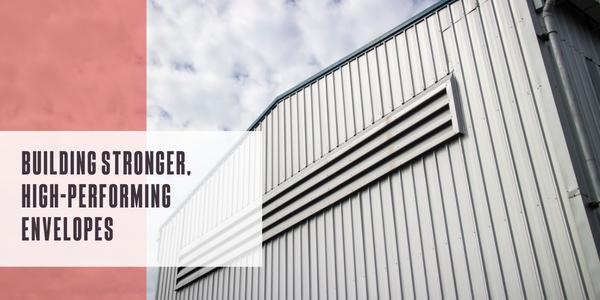
Building stronger, high-performing envelopes
By Jesse Sanchez.
Integrated design, careful installation and early collaboration can help commercial project teams prevent costly building envelope failures.
Building envelope failures can begin with something as small as an improperly sealed penetration or poorly detailed transition, but the consequences can spread throughout a commercial building. Water intrusion, corrosion, mold growth, energy loss, occupant complaints and expensive repairs can all result when enclosure systems fail to perform as intended. METALCON helps industry professionals better understand these risks by bringing together education, expertise and solutions focused on improving building envelope performance.
A building envelope includes the roof, exterior walls, insulation, air barriers, vapor retarders, flashing, sealants, windows, doors and the transitions connecting them. Together, those components manage water, air, heat and vapor. Their effectiveness depends not simply on individual product performance, but on how well the complete assembly works as a system.
Modern commercial buildings add another layer of complexity. As structures become tighter to improve energy efficiency and occupant comfort, installation errors can have greater consequences. Discontinuous air barriers, missing flashing details and improperly sealed penetrations can compromise an otherwise well-designed enclosure.
Many failures occur where systems and trade responsibilities intersect. Poor coordination between roofing, wall and insulation systems, field modifications, unsealed penetrations and inadequate barrier continuity can create moisture and thermal problems that may not appear until months or years after occupancy.
Early collaboration can reduce those risks. Architects, contractors, manufacturers and building-envelope specialists can work together to resolve roof-to-wall transitions, coordinate penetrations, maintain continuous air and water barriers and minimize costly field changes. During construction, pre-installation meetings, mock-ups, inspections and adherence to manufacturer guidelines can reinforce design intent.
The long-term benefits extend beyond water management. The U.S. Department of Energy’s Better Buildings Solution Center reports that the building envelope accounts for approximately 30% of the primary energy consumed in commercial buildings, highlighting the importance of insulation, glazing and air sealing decisions.
METALCON 2026, scheduled for Oct. 7-9 in Orlando, Florida, will include education focused on thermal efficiency, moisture management and preventing failures in roofing and wall systems.
Learn more about METALCON 2026 and its building envelope education opportunities!
Learn more about METALCON in their Coffee Shop Directory or visit www.metalcon.com.
About the author

Jesse is a writer for The Coffee Shops. When he is not writing and learning about the roofing industry, he can be found powerlifting, playing saxophone or reading a good book.
Recommended For You
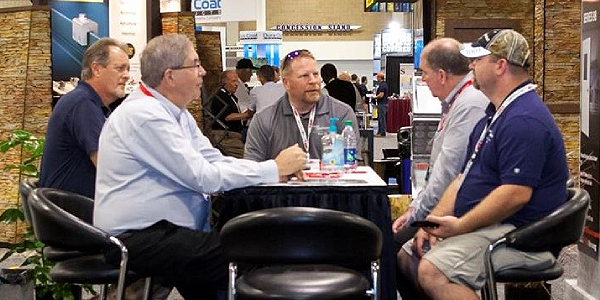
Metal minds in motion roundtables at METALCON
Read More ...
Get ready for Pantheon 2026
Read More ...
World of Concrete prioritizes education for 2026 attendees
Read More ...

Comments
Leave a Reply
Have an account? Login to leave a comment!
Sign In